element14 Community
element14 Community
    Register Log In
  • Site
  • Search
  • Log In Register
  • Community Hub
    Community Hub
    • What's New on element14
    • Feedback and Support
    • Benefits of Membership
    • Personal Blogs
    • Members Area
    • Achievement Levels
  • Learn
    Learn
    • Ask an Expert
    • eBooks
    • element14 presents
    • Learning Center
    • Tech Spotlight
    • STEM Academy
    • Webinars, Training and Events
    • Learning Groups
  • Technologies
    Technologies
    • 3D Printing
    • FPGA
    • Industrial Automation
    • Internet of Things
    • Power & Energy
    • Sensors
    • Technology Groups
  • Challenges & Projects
    Challenges & Projects
    • Design Challenges
    • element14 presents Projects
    • Project14
    • Arduino Projects
    • Raspberry Pi Projects
    • Project Groups
  • Products
    Products
    • Arduino
    • Avnet & Tria Boards Community
    • Dev Tools
    • Manufacturers
    • Multicomp Pro
    • Product Groups
    • Raspberry Pi
    • RoadTests & Reviews
  • About Us
  • Store
    Store
    • Visit Your Store
    • Choose another store...
      • Europe
      •  Austria (German)
      •  Belgium (Dutch, French)
      •  Bulgaria (Bulgarian)
      •  Czech Republic (Czech)
      •  Denmark (Danish)
      •  Estonia (Estonian)
      •  Finland (Finnish)
      •  France (French)
      •  Germany (German)
      •  Hungary (Hungarian)
      •  Ireland
      •  Israel
      •  Italy (Italian)
      •  Latvia (Latvian)
      •  
      •  Lithuania (Lithuanian)
      •  Netherlands (Dutch)
      •  Norway (Norwegian)
      •  Poland (Polish)
      •  Portugal (Portuguese)
      •  Romania (Romanian)
      •  Russia (Russian)
      •  Slovakia (Slovak)
      •  Slovenia (Slovenian)
      •  Spain (Spanish)
      •  Sweden (Swedish)
      •  Switzerland(German, French)
      •  Turkey (Turkish)
      •  United Kingdom
      • Asia Pacific
      •  Australia
      •  China
      •  Hong Kong
      •  India
      • Japan
      •  Korea (Korean)
      •  Malaysia
      •  New Zealand
      •  Philippines
      •  Singapore
      •  Taiwan
      •  Thailand (Thai)
      • Vietnam
      • Americas
      •  Brazil (Portuguese)
      •  Canada
      •  Mexico (Spanish)
      •  United States
      Can't find the country/region you're looking for? Visit our export site or find a local distributor.
  • Translate
  • Profile
  • Settings
Publications
  • Learn
  • More
Publications
Blog Graphene can repair itself when damaged
  • Blog
  • Documents
  • Events
  • Files
  • Members
  • Mentions
  • Sub-Groups
  • Tags
  • More
  • Cancel
  • New
Join Publications to participate - click to join for free!
  • Share
  • More
  • Cancel
Group Actions
  • Group RSS
  • More
  • Cancel
Engagement
  • Author Author: Catwell
  • Date Created: 13 Jul 2012 7:18 PM Date Created
  • Views 316 views
  • Likes 1 like
  • Comments 0 comments
  • research
  • graphene
  • industry
  • on_campus
  • cabeatwell
  • prototyping
  • university
  • innovation
Related
Recommended

Graphene can repair itself when damaged

Catwell
Catwell
13 Jul 2012

image

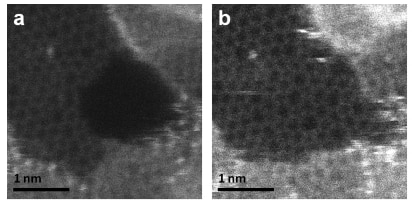
Graphene repairing images (via University of Manchester)


Graphene is poised as the next generation super-material. Its unusual properties such as its high-electron mobility which makes it the perfect choice for building transistors for super-fast CPUs. Another highly unusual property of the one-atom thick material was recently discovered by a team of physicists from the University of Manchester.  After studying graphene under an electron microscope, the team discovered that the material will knit itself back together if it receives damage.


The discovery was made while trying to understand graphenes behavior regarding its fabrication. It’s difficult creating large sheets of the material. It’s only one atom thick so it tends to ‘roll-up’ or ‘ball-up’ as carbon tends to bond with itself which results in damage or tearing of the graphene. In an effort to get a better understanding why this happens, the team studied the material for countless hours when they made the profound ‘healing’ discovery. They tested the knit-together properties by using an electron beam to punch a small hole in the material and then filled the hole with atoms of palladium and nickel which was found to bond to the edges of the graphene; preventing it from growing back together (which would result in tearing the sheet altogether). The team then found that if they added carbon atoms to the mix, they would displace the metal atoms and essentially re-knit the hole back together.


They found that the repaired graphene structure depended on the kind of carbon used. If they incorporated hydrocarbon, the repaired hole would result in defects as it has a different make-up over graphene’s hexagonal lattice shape. However, If they used pure carbon, the resulting repair would be a perfect match resulting in a pristine sheet of graphene. This means that graphene can be constructed into a variety of shapes using the displacement of metal by injecting atoms of pure carbon if the graphene sheet has defects. While the team states that further research is needed to fully understand the rate at which this healing process occurs, it could lead to objects such as cars and planes that could be self-healing after an accident.


Cabe

http://twitter.com/Cabe_e14


  • Sign in to reply
element14 Community

element14 is the first online community specifically for engineers. Connect with your peers and get expert answers to your questions.

  • Members
  • Learn
  • Technologies
  • Challenges & Projects
  • Products
  • Store
  • About Us
  • Feedback & Support
  • FAQs
  • Terms of Use
  • Privacy Policy
  • Legal and Copyright Notices
  • Sitemap
  • Cookies

An Avnet Company © 2025 Premier Farnell Limited. All Rights Reserved.

Premier Farnell Ltd, registered in England and Wales (no 00876412), registered office: Farnell House, Forge Lane, Leeds LS12 2NE.

ICP 备案号 10220084.

Follow element14

  • X
  • Facebook
  • linkedin
  • YouTube