element14 Community
element14 Community
    Register Log In
  • Site
  • Search
  • Log In Register
  • Community Hub
    Community Hub
    • What's New on element14
    • Feedback and Support
    • Benefits of Membership
    • Personal Blogs
    • Members Area
    • Achievement Levels
  • Learn
    Learn
    • Ask an Expert
    • eBooks
    • element14 presents
    • Learning Center
    • Tech Spotlight
    • STEM Academy
    • Webinars, Training and Events
    • Learning Groups
  • Technologies
    Technologies
    • 3D Printing
    • FPGA
    • Industrial Automation
    • Internet of Things
    • Power & Energy
    • Sensors
    • Technology Groups
  • Challenges & Projects
    Challenges & Projects
    • Design Challenges
    • element14 presents Projects
    • Project14
    • Arduino Projects
    • Raspberry Pi Projects
    • Project Groups
  • Products
    Products
    • Arduino
    • Avnet & Tria Boards Community
    • Dev Tools
    • Manufacturers
    • Multicomp Pro
    • Product Groups
    • Raspberry Pi
    • RoadTests & Reviews
  • About Us
  • Store
    Store
    • Visit Your Store
    • Choose another store...
      • Europe
      •  Austria (German)
      •  Belgium (Dutch, French)
      •  Bulgaria (Bulgarian)
      •  Czech Republic (Czech)
      •  Denmark (Danish)
      •  Estonia (Estonian)
      •  Finland (Finnish)
      •  France (French)
      •  Germany (German)
      •  Hungary (Hungarian)
      •  Ireland
      •  Israel
      •  Italy (Italian)
      •  Latvia (Latvian)
      •  
      •  Lithuania (Lithuanian)
      •  Netherlands (Dutch)
      •  Norway (Norwegian)
      •  Poland (Polish)
      •  Portugal (Portuguese)
      •  Romania (Romanian)
      •  Russia (Russian)
      •  Slovakia (Slovak)
      •  Slovenia (Slovenian)
      •  Spain (Spanish)
      •  Sweden (Swedish)
      •  Switzerland(German, French)
      •  Turkey (Turkish)
      •  United Kingdom
      • Asia Pacific
      •  Australia
      •  China
      •  Hong Kong
      •  India
      • Japan
      •  Korea (Korean)
      •  Malaysia
      •  New Zealand
      •  Philippines
      •  Singapore
      •  Taiwan
      •  Thailand (Thai)
      • Vietnam
      • Americas
      •  Brazil (Portuguese)
      •  Canada
      •  Mexico (Spanish)
      •  United States
      Can't find the country/region you're looking for? Visit our export site or find a local distributor.
  • Translate
  • Profile
  • Settings
Publications
  • Learn
  • More
Publications
Blog Graphene magnetic spin and solid state memory
  • Blog
  • Documents
  • Events
  • Files
  • Members
  • Mentions
  • Sub-Groups
  • Tags
  • More
  • Cancel
  • New
Join Publications to participate - click to join for free!
  • Share
  • More
  • Cancel
Group Actions
  • Group RSS
  • More
  • Cancel
Engagement
  • Author Author: Eavesdropper
  • Date Created: 19 Apr 2011 2:25 AM Date Created
  • Views 619 views
  • Likes 1 like
  • Comments 1 comment
  • research
  • graphene
  • eavesdropper:dit
  • spintronics
  • on_campus
  • magnetic_moment
  • university
  • kondo
  • innovation
Related
Recommended

Graphene magnetic spin and solid state memory

Eavesdropper
Eavesdropper
19 Apr 2011
image
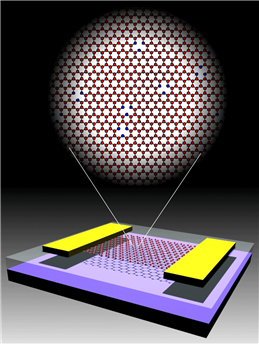
Vacancies surrounded by blue particles in the picture above.
 
Another graphene discovery shows graphene's magnetic potential. In an atom thick graphene sheet, there is a common defect of missing atoms, dubbed "Vacancies." Michal S. Fuhrer, of the University of Maryland, has discovered that the vacancies have a magnetic moment, a small magnetic field. The magnetism also creates an additional electrical resistance in the surrounding atoms at low temperatures, known as the Kondo Effect.
 
Fuhrer hypothesizes that many magnetic moments could be coupled via the Kondo effect, causing all of them to line up in the same direction. He continues, " The result would be a ferromagnet, like iron, but instead made only of carbon. Magnetism in graphene could lead to new types of nanoscale sensors of magnetic fields. And, when coupled with graphene's tremendous electrical properties, magnetism in graphene could also have interesting applications in the area of spintronics, which uses the magnetic moment of the electron, instead of its electric charge, to represent the information in a computer."
 
Spintronics may lead to future solid state devices. Motorola has already produced memory based on this principle called MRAM, Magnetoresistice random access memory.  No charge pump is needed with MRAM. Which leads to faster operation, lower power consumption, and a long lifespan. (Via Wiki.)
 
Eavesdropper
 
pic via University of Maryland
  • Sign in to reply
  • DAB
    DAB over 14 years ago

    It sounds to me like they need to get the graphene latice structure to vibrate during formation.  At the right frequency, the electrons and atoms would fill the vacancies to get a uniform material formation.  If I can find some time, I may look into their production process.  It might be possible to tweek either the temperature or add a microwave stimulation to get a purer batch of material.


    Thanks

    DAB

    • Cancel
    • Vote Up 0 Vote Down
    • Sign in to reply
    • More
    • Cancel
element14 Community

element14 is the first online community specifically for engineers. Connect with your peers and get expert answers to your questions.

  • Members
  • Learn
  • Technologies
  • Challenges & Projects
  • Products
  • Store
  • About Us
  • Feedback & Support
  • FAQs
  • Terms of Use
  • Privacy Policy
  • Legal and Copyright Notices
  • Sitemap
  • Cookies

An Avnet Company © 2026 Premier Farnell Limited. All Rights Reserved.

Premier Farnell Ltd, registered in England and Wales (no 00876412), registered office: Farnell House, Forge Lane, Leeds LS12 2NE.

ICP 备案号 10220084.

Follow element14

  • X
  • Facebook
  • linkedin
  • YouTube