element14 Community
element14 Community
    Register Log In
  • Site
  • Search
  • Log In Register
  • Community Hub
    Community Hub
    • What's New on element14
    • Feedback and Support
    • Benefits of Membership
    • Personal Blogs
    • Members Area
    • Achievement Levels
  • Learn
    Learn
    • Ask an Expert
    • eBooks
    • element14 presents
    • Learning Center
    • Tech Spotlight
    • STEM Academy
    • Webinars, Training and Events
    • Learning Groups
  • Technologies
    Technologies
    • 3D Printing
    • FPGA
    • Industrial Automation
    • Internet of Things
    • Power & Energy
    • Sensors
    • Technology Groups
  • Challenges & Projects
    Challenges & Projects
    • Design Challenges
    • element14 presents Projects
    • Project14
    • Arduino Projects
    • Raspberry Pi Projects
    • Project Groups
  • Products
    Products
    • Arduino
    • Avnet & Tria Boards Community
    • Dev Tools
    • Manufacturers
    • Multicomp Pro
    • Product Groups
    • Raspberry Pi
    • RoadTests & Reviews
  • About Us
  • Store
    Store
    • Visit Your Store
    • Choose another store...
      • Europe
      •  Austria (German)
      •  Belgium (Dutch, French)
      •  Bulgaria (Bulgarian)
      •  Czech Republic (Czech)
      •  Denmark (Danish)
      •  Estonia (Estonian)
      •  Finland (Finnish)
      •  France (French)
      •  Germany (German)
      •  Hungary (Hungarian)
      •  Ireland
      •  Israel
      •  Italy (Italian)
      •  Latvia (Latvian)
      •  
      •  Lithuania (Lithuanian)
      •  Netherlands (Dutch)
      •  Norway (Norwegian)
      •  Poland (Polish)
      •  Portugal (Portuguese)
      •  Romania (Romanian)
      •  Russia (Russian)
      •  Slovakia (Slovak)
      •  Slovenia (Slovenian)
      •  Spain (Spanish)
      •  Sweden (Swedish)
      •  Switzerland(German, French)
      •  Turkey (Turkish)
      •  United Kingdom
      • Asia Pacific
      •  Australia
      •  China
      •  Hong Kong
      •  India
      • Japan
      •  Korea (Korean)
      •  Malaysia
      •  New Zealand
      •  Philippines
      •  Singapore
      •  Taiwan
      •  Thailand (Thai)
      • Vietnam
      • Americas
      •  Brazil (Portuguese)
      •  Canada
      •  Mexico (Spanish)
      •  United States
      Can't find the country/region you're looking for? Visit our export site or find a local distributor.
  • Translate
  • Profile
  • Settings
Publications
  • Learn
  • More
Publications
Blog Graphene-silicon hybrid lithium-ion battery, unmatched performance
  • Blog
  • Documents
  • Events
  • Files
  • Members
  • Mentions
  • Sub-Groups
  • Tags
  • More
  • Cancel
  • New
Join Publications to participate - click to join for free!
  • Share
  • More
  • Cancel
Group Actions
  • Group RSS
  • More
  • Cancel
Engagement
  • Author Author: Catwell
  • Date Created: 17 Nov 2011 12:42 AM Date Created
  • Views 437 views
  • Likes 0 likes
  • Comments 0 comments
  • alternative_energy
  • on_campus
  • battery
  • cabeatwell
  • prototyping
  • university
  • innovation
Related
Recommended

Graphene-silicon hybrid lithium-ion battery, unmatched performance

Catwell
Catwell
17 Nov 2011
imageimage
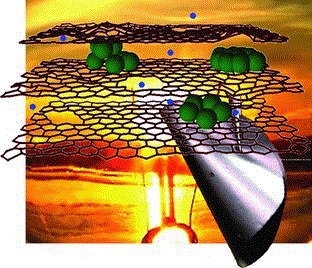
Graphical depiction of the battery anode layers (left) Harold Kung (right)
 
While working with battery technology, Northwestern University Professor Harold Kung has come up with a novel configuration for lithium batteries that yield 10 times the capacity with a tenth of the charge time versus industry standard. The development is an elegant mix of old and new that
 
The research team took the concept of a graphene based anode and combined it with the old tried and true silicon. Graphene can  store 1 lithium atom for every 6 carbon atoms. The team tried a purely silicon anode, and was able to store 4 lithium atoms for every 1 silicon. However, silicon expands greatly during rapid recharging, making it not usable for most purposes. Their first step was to sandwich layers of silicon between those of the graphene. 
 
Kung explained, "Now we almost have the best of both worlds. We have much higher-energy  density because of the silicon, and the sandwiching reduces the capacity loss caused by the silicon expanding and contracting. Even if the silicon clusters break up, the silicon won’t be lost.”
 
Charging time still remained an issue for the team. The charging time was limited by the shape of the graphene sheets, which have rather large overall surface area. In the charging process, a lithium-ion must travel to the edges of the graphene sheet before finding its place somewhere between the layers. The result is a long charge time. To combat this issue, the team used chemical oxidation to make 10-20 nanometer holes in the graphene layers, they budded "in-plane defects." The defects create a shortcut for the ions to the silicon storage layers. In the end, the team saw a charge time 10 times faster than anything currently available.
 
I am most interested in the portable gadget arena for their tech. No longer worrying about charging every 4 hours, or waiting 8 hours to replenish, sounds like a dream come true. Graphene finally finds a wide spread use. I am looking forward to more news from Northwestern.
 
Cabe
http://twitter.com/Cabe_e14
  • Sign in to reply
element14 Community

element14 is the first online community specifically for engineers. Connect with your peers and get expert answers to your questions.

  • Members
  • Learn
  • Technologies
  • Challenges & Projects
  • Products
  • Store
  • About Us
  • Feedback & Support
  • FAQs
  • Terms of Use
  • Privacy Policy
  • Legal and Copyright Notices
  • Sitemap
  • Cookies

An Avnet Company © 2026 Premier Farnell Limited. All Rights Reserved.

Premier Farnell Ltd, registered in England and Wales (no 00876412), registered office: Farnell House, Forge Lane, Leeds LS12 2NE.

ICP 备案号 10220084.

Follow element14

  • X
  • Facebook
  • linkedin
  • YouTube