


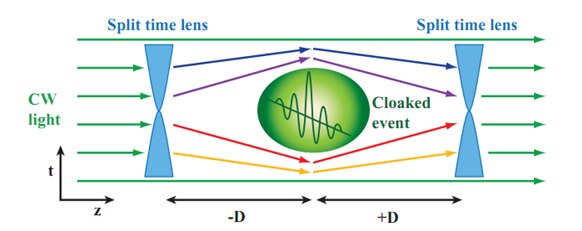
Temporal Cloak, hiding an event in time. (via A temporal cloak at telecommunication data rate)
The ideas of Einstein and his predecessors are still making waves today and now, researchers at many universities are using space-time duality, along with metamaterials, to bend light waves and time in a way that destructively interfere. This interference, due to the good old Talbot effect, can result in a “hole in time” and realization of a sci-fi lover’s dream; time cloaking.
Though it may be a tad early to be planning your unnoticed travel through time, scientists at Imperial College London, Cornell University and now Purdue have successfully used the technique to make light beams invisible, even if just for nanoseconds.
The method is possible because of relativistic electromagnetic theory that mathematically equates the spatial diffraction of light and temporal, or time, dispersion as per space-time duality. Another breakthrough of engineering that makes this possible is the manufacture of metamaterials that interact with light in ways unlike anything natural. These metamaterials can manipulate light digitally to slow it as it travels through them and they can have negative refractive indexes.
Using two time lenses made of metamaterials, the team dispersed one incoming light signal using the first lens, and then compresses it again with a second lens. If this process happens at the correct frequency, the Talbot effect says they can theoretically interfere destructively and disappear for a moment.
This method will not be concealing any bank robberies anytime soon, but it can however be used to manipulate optical data in a way that can create interrupt-without-interrupt data communication. In this application, data can be sent between normal processes, disguised with a time hole, without there being any detection of interruption.
Previous experiments at Cornell and Imperial College gave opportunity to hide events for around 120 nanoseconds at a frequency of 41 kHz. This frequency was much too small to hide data in optical communication. But Joseph Lukens, electrical engineer at Purdue University took idea one step further and paired the two-lenses set up with a phase modulator that allows him to use oscillating voltages to further manipulate the speed of light passing through it.
With his phase modulator, Lukens was able to increase the frequency at which time holes can be created. This increase was so great that he was able to transmit data at 12.7 GBPS while cloaking “46% of the time axis,” effectively hiding the data transfer.
This type of time cloak could give rise to ultra-secure and instantly prioritized optical communication. Likewise, it is possible that this same technique could be ultra-intrusive, although this may require the inclusion of time lenses within an optical communication system first.
The longest event that could be theoretically hidden using this type of event cloaking is only in the order of magnitude of microsecond. But, if Einstein taught us anything it was that our scientific perception of reality changes. It could take one revolutionary thinker or one tweak to modern physics to expand time cloaks upon a broader horizon. And yes, some have suggested making a “circle of time” lens to travel back in time...
C
See more news at: