


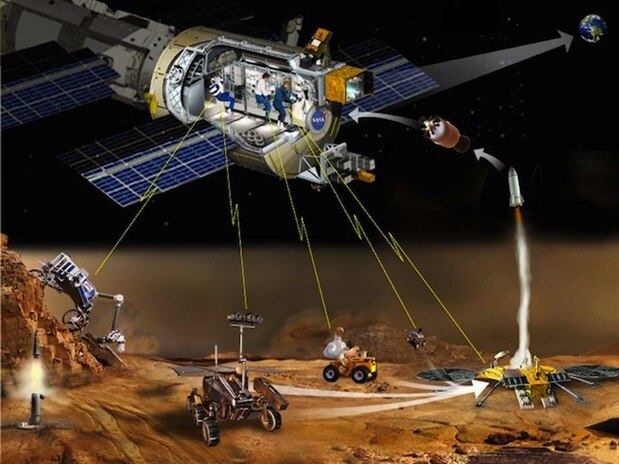
A human crew in orbit around Mars controls a suite of robotic surrogates, including a rover, climbing-bot, and miniature sample-return rocket.
Before Apollo 11 landed on the moon Apollo missions 8 and 10 tested various components while orbiting the moon, and returned photography of the lunar surface, paving the way for Neil Armstrong’s “One Giant Leap for Mankind”
A workshop was held recently by the Planetary Society to build consensus on the key elements of a long-term, cost constrained, executable program to send humans to Mars. The 70 attendees suggested a similar, orbit-first approach to human exploration of the red planet.
The questions explored during the event included: is it possible to find an approach that is affordable within a plausible NASA budget for the next 15 years (i.e. 2% - 3% growth to match inflation)? Would it be valuable scientifically? Would people find it engaging?
The Planetary Society’s CEO Bill Nye (yes, “The Science Guy”) and members of the Society’s Board of Directors this week presented results of the workshop. Said Nye: “Getting humans to Mars is far more complex than getting to Earth’s Moon. But space exploration brings out the best in us. By reaching consensus on the right set of missions, we can send humans to Mars without breaking the bank.”
Called “Humans Orbiting Mars,” the plan explored the idea of taking an orbit-first approach to an extended program of human exploration of the planet. It was pointed out that this isn’t orbit-only, but simply considered the idea of intermediate steps within a long-term program as a way to constrain the cost.
Workshop attendees concluded that an orbital mission in 2033 is required that will enable scientific exploration of Mars while exploring Mars’ moons Phobos or Demos in person and developing essential experience in human travel from Earth to the Mars system. The 30-month human mission to Mars orbit in 2033 would provide approximately one year spent at the planet. During that time the crew could explore and tele-operate rovers on the planet’s surface with a much shorter communications lag than from Earth. Landing humans on Mars could then more affordably and logically follow later, perhaps in 2039.
It has been estimated that sticking with NASA’s human spaceflight budget as it exists and using NASA’s current “Evolvable Mars” strategy would place humans on Mars not sooner than 2050.
Under “Humans Orbiting Mars” the Planetary Society would expect NASA to complete work on its heavy-lift Space Launch System and Orion crew vehicle as planned, and once the International Space Station reaches its expected shutdown date in 2024 NASA would shift the budget it uses for ISS to the Mars-mission project. An independent cost estimate showed that such a program would fit within a budget that grows with inflation after NASA ends its lead role in the ISS.
A full report on the “Humans Orbiting Mars” workshop will be released later in the year.
Top Comments