


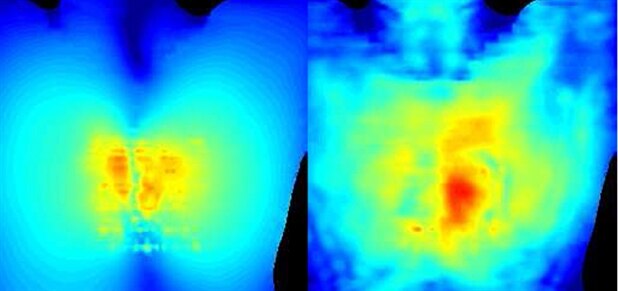
(Left) Low freequency 200MHz power transfer (Right) 1.7GHz power transfer. Red indicates higher power. (via Stanford)
The heart is a pump that works tirelessly until the very end. Implants to help those with heart problems are powered by voluminous, finite batteries, which present a problem to the seemingly perpetual heart. Wireless powering has been disregarded as not practical with implanted devices, but science is full of rebellious thinkers.
Electrical Engineer Ada S.Y. Poon and her team at Stanford have shown that is very possible and actually very efficient to use mid-field powering, which uses a combination of inductive and radiating modes to deliver energy wirelessly to devices used within the human body.
The mid-field technique works by tuning identical resonators to produce constructively interfere. This is achieved by correct choice of resistors within the transmitter and receiver circuits. The team created an innovative antenna that focuses radio waves at the receiver as opposed to within bodily tissue and works within the IEEE safety guidelines. The antennae design also allows for adequate power transmission regardless of the orientation of the receiver and transmitter.
Results show that optimum resonance occurs at about 1.7 GHz and delivers 50 micro Watts of power with a 1-mm radius coil antenna. This is more than enough power to operate a pacemaker that usually uses about 8 microwatts.
This device is not limited to heart applications. Poon and her team have suggested using this system to power any implantable device including precision brain stimulators and pillcams that travel the digestive tract.
Much work is still being done. The team wants to perfect the design of their antennae but their research has proven the concept of wireless energy delivery and shattered the claims of previous neigh Sayers. Is that not what science is perpetually all about?
Cabe

