


"I always feel like somebody's watching me" - Kennedy "Rockwell" Gordy
Every year computers become more adept at interaction with their human users. Whether it is to help around the house or while shopping, computers are with us at most moments during the day to help us out. Soon, they will even know us by face, track our emotions and help us find the things we always seem to misplace.

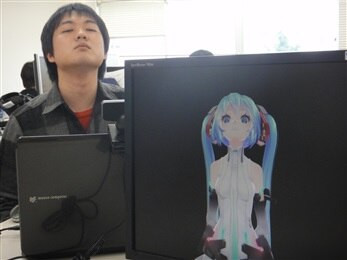
(Left) Facial tracking (Right) Avatar control (via Keio University)
At Keio University, in Tokyo, Associate Professor Yasue Matsukura and his team are developing methods to perform effective face recognition in real time, simply using a regular PC and a USB webcam. The system tracks the eyes, nose and mouth at high speeds using a continuously updating algorithm that tracks facial orientation and expression with remarkable precision. We are sure to see this type of tech in games, video production, and general interaction in the near future. The team is working on software that could be installed on any PC that would enable facial recognition to be accessible on a wide scale. The camera-type restrictions are not known at this time.
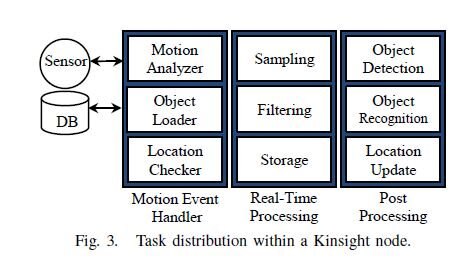
Kinsight block diagram concept (via University of Virginia)
On another project, Computer Scientists, Shahriar Nirjon and John Stankovic, from the University of Virginia are developing software called Kinsight, which modifies the Kinect camera to recognize and keep track of objects around your home. After manually tagging items, the Kinect camera can track them around its field of view. When something goes missing, you simply search the Kinsight memory to find what you’re looking for. It even learns to track duplicates of the same objects. Although a Kinect sensor costs around $120 per unit, the team states that an array of Kinects is 4-16 time cheaper than a RFID tracking system for the same objects. Read more about the Kinsight here.
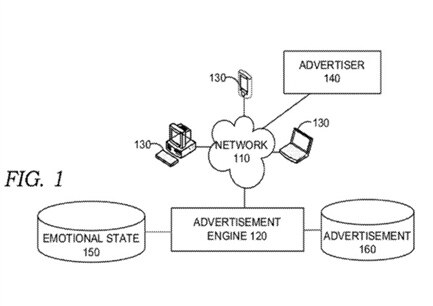
Your emotions to ads, the concept (via Microsoft and USPTO)
Of course, facial and object recognition could be used for a myriad of applications. Microsoft has attempted to patent at least one application that would use the Kinect to look at your emotions. As I am sure most of you have noticed, social networks make use of all the information you output like keywords, tags and things you publicly liked, to tailor advertisements to you. Microsoft wishes to use their Kinect camera to perform facial recognition to aid in advertisement management. They suggest that, as you watch TV or play a game, the Kinect could watch your facial expressions and use this information to advertize to the emotions it detects. This peeping could extend to seeing your reaction to emails and keywords, as well. The company filed a patent for this application but it is unclear exactly how your privacy wishes will be considered.
If this ever becomes implemented, I hope the Kinect will realize I loath all advertisements and stop sending them to me. In any case, your computer may soon recognize all sorts of objects in the material world and may even attempt to understand your emotional world.
Cabe

