


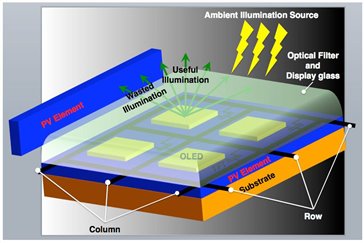
Concept drawing of the recovery PV element under a screen (via Arokia Nathan)
A team or researchers from the University of Cambridge are setting out to develop cell phones that require less charging by integrating photovoltaic (PV) cells and other energy harvesting mechanisms inside. They believe that eventually cell phones will not have to be plugged in at all. However, they are just beginning to take on that challenge. Recovering every arrant bit of energy is the key.
IEEE member Arokia Nathan, and his team, are putting PV elements under the display to use its large surface area to collect photons and generate electricity. The team has also found that OLED cell phone displays waist 64% of the light generated. Most of the light instead leeks out the sides of the display, so a solution to this issue was to place PV cells around the edges as well to absorb those extra photons. The PV cells also absorb ambient light In an average 3.7 in Smartphone screen, the PV cells could generate 5% of ambient light to electricity. At 165 microwatts per square cm, they could generate 5 milliwatts total, under adequate lighting conditions. Not a lot, but it is some recovered energy.
After collecting the excess electrons, the team had to deal with the fluctuating voltage. A thin film transistor circuit was designed to level off these fluctuations. This film can be manufactured at 150 degrees Celsius and can be implemented in any handheld device. A super capacitor was also implemented for intermediate energy storage to avoid charging the battery directly and protect it from voltage fluctuations.
The combination of PV cells, transistors and super capacitors give an energy generation and storage efficiency of 18% at the maximum and 11% on average.
Other energy generation solutions have been thought up. Magnetic resonance coupling using thin- film conductive coils, and microelectromechanical kinetic energy harvesting are just two examples.
More development and research needs to be done for a consumer product prototype, but it is comforting to know there will be a day when the lack of a phone charger will ruin your day.
The lesson here: Our electronics need to have a more elegant and efficient design.
IEEE member Arokia Nathan, and his team, are putting PV elements under the display to use its large surface area to collect photons and generate electricity. The team has also found that OLED cell phone displays waist 64% of the light generated. Most of the light instead leeks out the sides of the display, so a solution to this issue was to place PV cells around the edges as well to absorb those extra photons. The PV cells also absorb ambient light In an average 3.7 in Smartphone screen, the PV cells could generate 5% of ambient light to electricity. At 165 microwatts per square cm, they could generate 5 milliwatts total, under adequate lighting conditions. Not a lot, but it is some recovered energy.
After collecting the excess electrons, the team had to deal with the fluctuating voltage. A thin film transistor circuit was designed to level off these fluctuations. This film can be manufactured at 150 degrees Celsius and can be implemented in any handheld device. A super capacitor was also implemented for intermediate energy storage to avoid charging the battery directly and protect it from voltage fluctuations.
The combination of PV cells, transistors and super capacitors give an energy generation and storage efficiency of 18% at the maximum and 11% on average.
Other energy generation solutions have been thought up. Magnetic resonance coupling using thin- film conductive coils, and microelectromechanical kinetic energy harvesting are just two examples.
More development and research needs to be done for a consumer product prototype, but it is comforting to know there will be a day when the lack of a phone charger will ruin your day.
The lesson here: Our electronics need to have a more elegant and efficient design.
Cabe
