


Technology today is increasing faster than ever. With this increase electrically powered devices, there should be a linear increase in battery technology powering these devices. It appears that battery tech is not keeping pace with device innovation. Although there have been many breakthroughs in battery research, advancements in batteries are very slow to hit the market. Energy density in batteries improve every year by about 7% where as it should and is capable of increasing around 15% every year. Intel is one company struggling with these problems as they look to reduce their Ultrabook costs.
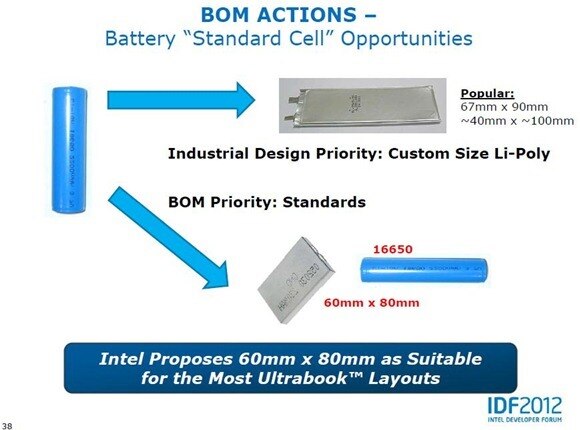
Intel has been searching for some time now for the best fit battery for their Ultrabook. Their main goal is to lower the cost of the unit but without diminishing the life cycle. Additionally, they would ideally like it to have a faster charge time and the ability to deliver short-term high power boosts. After input from many professionals, they have narrowed their selection down to two possible solutions. One being Sanyo's and BAK's 16650 cylindrical battery and the other being a prismatic lithium ion battery. However, both possess their drawbacks. The prismatic batteries are more expensive while the 16650 batteries' market is dominated by their Asian manufacturing companies.
As of now no choice has been made as for which one may be finding its new home in Ultrabooks. Intel is slightly leaning towards the 16650 due to its balance of size, capacity, and cost. The 16650 does not provide an improvement in capacity, however. Hopefully before Intel settles upon a choice they think about pursuing new battery designs. Intel is one of very few organizations that have the power to push the battery market to its full capability. When Intel steps in it may start a domino effect of electronic manufactures rallying for new batteries. If enough people work together, we may soon see the battery breakthroughs we have been reading about on the markets.
Cabe
