element14 Community
element14 Community
    Register Log In
  • Site
  • Search
  • Log In Register
  • Community Hub
    Community Hub
    • What's New on element14
    • Feedback and Support
    • Benefits of Membership
    • Personal Blogs
    • Members Area
    • Achievement Levels
  • Learn
    Learn
    • Ask an Expert
    • eBooks
    • element14 presents
    • Learning Center
    • Tech Spotlight
    • STEM Academy
    • Webinars, Training and Events
    • Learning Groups
  • Technologies
    Technologies
    • 3D Printing
    • FPGA
    • Industrial Automation
    • Internet of Things
    • Power & Energy
    • Sensors
    • Technology Groups
  • Challenges & Projects
    Challenges & Projects
    • Design Challenges
    • element14 presents Projects
    • Project14
    • Arduino Projects
    • Raspberry Pi Projects
    • Project Groups
  • Products
    Products
    • Arduino
    • Avnet & Tria Boards Community
    • Dev Tools
    • Manufacturers
    • Multicomp Pro
    • Product Groups
    • Raspberry Pi
    • RoadTests & Reviews
  • About Us
  • Store
    Store
    • Visit Your Store
    • Choose another store...
      • Europe
      •  Austria (German)
      •  Belgium (Dutch, French)
      •  Bulgaria (Bulgarian)
      •  Czech Republic (Czech)
      •  Denmark (Danish)
      •  Estonia (Estonian)
      •  Finland (Finnish)
      •  France (French)
      •  Germany (German)
      •  Hungary (Hungarian)
      •  Ireland
      •  Israel
      •  Italy (Italian)
      •  Latvia (Latvian)
      •  
      •  Lithuania (Lithuanian)
      •  Netherlands (Dutch)
      •  Norway (Norwegian)
      •  Poland (Polish)
      •  Portugal (Portuguese)
      •  Romania (Romanian)
      •  Russia (Russian)
      •  Slovakia (Slovak)
      •  Slovenia (Slovenian)
      •  Spain (Spanish)
      •  Sweden (Swedish)
      •  Switzerland(German, French)
      •  Turkey (Turkish)
      •  United Kingdom
      • Asia Pacific
      •  Australia
      •  China
      •  Hong Kong
      •  India
      • Japan
      •  Korea (Korean)
      •  Malaysia
      •  New Zealand
      •  Philippines
      •  Singapore
      •  Taiwan
      •  Thailand (Thai)
      • Vietnam
      • Americas
      •  Brazil (Portuguese)
      •  Canada
      •  Mexico (Spanish)
      •  United States
      Can't find the country/region you're looking for? Visit our export site or find a local distributor.
  • Translate
  • Profile
  • Settings
Publications
  • Learn
  • More
Publications
Blog Is Fogale Nanotech’s Sensation Technology the future of capacitive touch?
  • Blog
  • Documents
  • Events
  • Files
  • Members
  • Mentions
  • Sub-Groups
  • Tags
  • More
  • Cancel
  • New
Join Publications to participate - click to join for free!
  • Share
  • More
  • Cancel
Group Actions
  • Group RSS
  • More
  • Cancel
Engagement
  • Author Author: Catwell
  • Date Created: 1 Jul 2013 8:04 PM Date Created
  • Views 797 views
  • Likes 1 like
  • Comments 1 comment
  • research
  • touch
  • industry
  • hmi
  • embedded
  • cabeatwell
  • prototyping
  • measurement
  • fogale_nanotech
  • sensor
  • innovation
  • communication
Related
Recommended

Is Fogale Nanotech’s Sensation Technology the future of capacitive touch?

Catwell
Catwell
1 Jul 2013

image

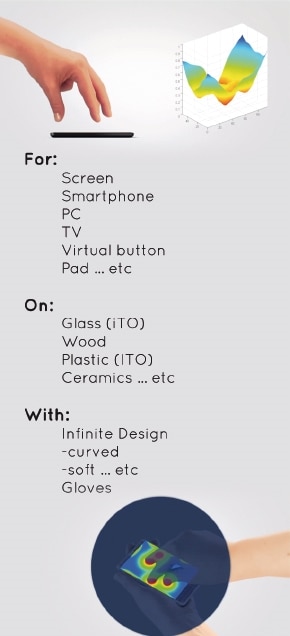
Sensation Technology concept...in words (via Fogale Nanotech)


Most current mobile devices use capacitive-based touchscreens in order to navigate and interact with apps. The popular screens work by using an insulating layer, in this case glass, which is coated with a transparent conductive material such as ITO (Indium Tin Oxide). The conductive material holds a minute uniform electrical charge spread out evenly over the screen area. Humans also carry a small amount of electrical conductivity, and when the user touches the screen, the electrical field is disrupted at the precise point of contact. The electrical information is then processed by a controller (a link between two pieces of hardware) that results in interaction with applications or programs. These screens have both advantages and disadvantages over other types of touch-based hardware such as resistive-based screens that use two electrically resistive layers that come in contact with one another when touched providing a location-based contact point. While capacitive-based screens are indeed more precise over its resistive counterpart, they are more expensive to manufacture because of the materials involved. On the other hand, the screen needs another electrical conducive material (human fingers) which is canceled out if the user is wearing gloves or other material. Resistive-based screens do not suffer from this, which is why the screen can be used with nonconductive objects such as a stylus.


Not satisfied with current capacitive touchscreen technology, Fogale Nanotech is developing a new type of interactive display that combines the popular capacitive touch feature most mobile devices use and combines that with a gestural aspect as well. Called Sensation, Fogale’s new screen is outfitted with a series electrodes embedded on one of the screen’s layers which is able to pick up a tiny amount of electrical capacitance even from a distance. The basis for the screen was taken from the sensor used in most CMOS cameras, which converts light into electrons that are then translated into pixels creating an image. The Sensation functions in much the same way as each individual electrode embedded in the screen senses capacitance and distance of an object hovering over it. Specialized algorithms take the data gathered form the electrodes and reconstructs the object in 3D near the screen in real-time almost like there were Kinect sensors positioned around the users hand. Interaction with apps can be done using hand gestures such as scrolling through menus with a fingertip or zooming in and out by positioning your hand closer or further away from the screen. The only drawback the technology has is that your hand must be no further than 10 centimeters from the screen, however it’s still impressive to say the least as its able to detect real-time ‘hovering’ in its proximity. Hovering allows the user to select applications just by, well hovering over them instead of tapping the program. The Sensation technology is almost 100 times more precise in object detection and movement than any other capacitive-based tech currently on the market. This precision makes the screen an invaluable tool for surgeons who need to manipulate an image without physically touching an unsterile screen. As it stands at this point in time, the Sensation technology is still being refined so don’t expect to see next-gen mobile devices outfitted with the technology anytime soon.


Although it looks fake, this video is not.


C

See more news at:

http://twitter.com/Cabe_e14

  • Sign in to reply
  • DAB
    DAB over 12 years ago

    Very interesting.

    I suspect that we are just beginning to see some innovative uses in capacitive technology.

    As the algorithms and electronics improve, there is a lot more interesting applications inwhich they can be used.


    DAB

    • Cancel
    • Vote Up 0 Vote Down
    • Sign in to reply
    • More
    • Cancel
element14 Community

element14 is the first online community specifically for engineers. Connect with your peers and get expert answers to your questions.

  • Members
  • Learn
  • Technologies
  • Challenges & Projects
  • Products
  • Store
  • About Us
  • Feedback & Support
  • FAQs
  • Terms of Use
  • Privacy Policy
  • Legal and Copyright Notices
  • Sitemap
  • Cookies

An Avnet Company © 2026 Premier Farnell Limited. All Rights Reserved.

Premier Farnell Ltd, registered in England and Wales (no 00876412), registered office: Farnell House, Forge Lane, Leeds LS12 2NE.

ICP 备案号 10220084.

Follow element14

  • X
  • Facebook
  • linkedin
  • YouTube