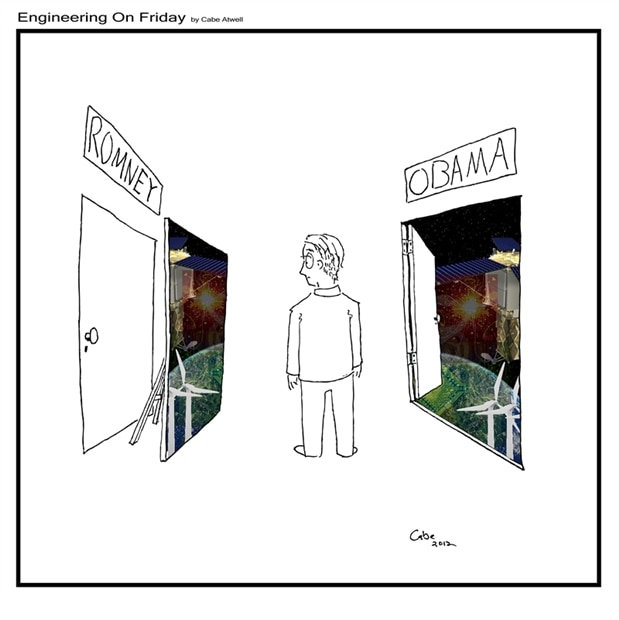
Mitt Romney "won" the first debate, gaining much attention for almost two week. He even caught up in the many political polls.
Mitt Romney, without a doubt, lost the second debate. He was insulting and aggressive with little justification. He looked like a carnival barker.
While people debate whether his campaign is in trouble or not, let's take a detailed look at how he plans to help engineers and the technology sector. I hope this will help you better understand the lesser known candidate.
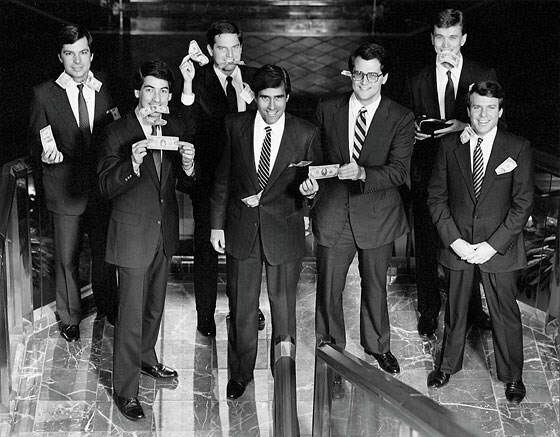
Mitt Romney (Center) at Bain Capital
Presidential candidates consistently make promises during their build-up to the election. Most of those promises crash and burn when the President takes office, while others slowly wither into the mundane. Take President Eisenhower’s Interstate Highway System, which was actually designed to evacuate people from cities and mobilization of the military in the event of a war on the US. Today’s candidates are pledging a commitment to increase innovation in the technology sector. This area has been responsible for growth in over half of America’s economy since World War 2 (Manhattan Project anyone?), so it is essential to bolster the industry. If elected, will GOP candidate Mitt Romney adhere to his promises and invigorate new innovation in technology or will his pledge fizzle-out if he steps into the Oval Office? Examining his policies (and perhaps the motives behind them) will likely give some insight on whether or not he can live up to his promises or if it’s just political rhetoric to garner votes.
Alternative Energy.

Nellis Solar Power Plant
Alternative energy (solar, wind, hydro, wave, etc.) resources have been thrust into the lime-lite as a substitute over the ever-decreasing carbon-based fossil fuel supply around the globe. According to an estimation from the Oil & Gas Journal, proved known oil reserves alone will be depleted in 43 years, along with an optimistic 167 years for natural gas, and 417 for coal (the estimates were based on a constant steady rate of acquisition and consumption with no increase in demand). The fact is that demand for these resources has risen sharply (with China, Russia and India increasing their dependency as of late), and as the population continues to rise the resources begin to fall so it’s only logical that we look to alternatives of renewable energy as a suitable replacement. No matter who steps into the White House one thing is for certain; they will have to take a hard look at alternative energy resources and the technology needed to implement them. Mitt Romney has unequivocally stated that he ‘will invest in new technologies and continue the Department of Energy’s critical basic research on alternative resources’. Romney’s ultimate goal for alternative energy is to make America ‘energy independent,’ which he states ‘will require technology that allows us to use energy more efficiently in our cars, homes and businesses’ as well as increasing the use of biodiesel, ethanol and nuclear power (see http://aboutmittromney.com/energy.htm). Obviously this must be done through ‘basic research’ from the Department of Energy otherwise it will require investment into companies that can provide innovation in new technologies but have the possibility of failure (such as that of Solyndra). Innovation often comes through failure, which requires us to try again and again until the desired end-result is achieved.
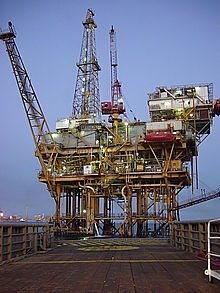
Gulf of Mexico oil drilling platform
Innovation and research into new technologies or implementation using existing tech is "third" on Romney’s list regarding his energy independence plan. The first two parts consist of ‘dramatic regulatory reform’ related to exploration (drilling) and development of both oil and gas infrastructure (refinery refinements?) along with ‘modernizing outdated environmental EPA laws (see http://www.mittromney.com/issues/energy). He states this will stop the EPA from using ‘imaginary benefits to justify onerous burdens’ when it comes to the use of coal and fracking techniques. Significant EPA law reduction will also help further his goal to continue off-shore drilling in the Gulf of Mexico, the Alaska National Wildlife Refuge and the Outer Continental Shelf in an effort to become less dependent on foreign fossil energy. While this may ‘wean’ the USA off of foreign oil and create jobs, which the economy so sorely needs, it doesn’t necessarily scream ‘technological innovation’ (or just innovative for that matter). His plan plainly doesn’t include any significant renewable alternative energy refinements or implementation that would have a positive impact on decreasing use of fossil fuels. So chances are you may not see any pledge regarding the issue of innovation in alternative energy come to fruition if Romney wins the Oval Office.
The Internet and net neutrality.

Routing paths through the internet from the Opte Project
New media outlets create additional ways of spinning pledges and the 21st century has seen the adoption of Facebook, YouTube (incorporated into the 2008 debates) and Twitter by both presidential candidates. While President Obama was quick to incorporate these various social media outlets Romney has them at his disposal as well (although he hasn’t really taken advantage of them) but what exactly are his views regarding the internet on matters such as net neutrality or management (regulation). When it comes to both of these topics people generally split off into one of two ‘camps’. Those that support them and those that are strongly opposed to any regulation what so ever. Generally the first camp is comprised of companies and corporations (mainly internet service providers) that want regulation in an effort to curtail online piracy and generate increased revenue through a ‘tiered service model’ (price-points based on bandwidth used). This means that those companies can restrict what and where the user can visit or do based off of the rates the user has paid (‘no downloads or streaming for you’!). Going over these rates would entail penalties such as fines or even jail sentences for those pirating illegal software. The other camp would like the internet to remain open and unregulated and see regulation as ‘data discrimination’ (selective filtering of information). They maintain that having an unregulated internet would encourage competition of broadband providers to offer better services over their counterparts, thereby not only creating a type of quality standard but also encourage economic growth for said companies.
Governor Romney (taken from an interview provided by sciencedebate.org) stated that he’s opposed to any management of the internet and affirms that ‘the non- governmental multi-stakeholder model’ is the ideal solution which states that non-governmental regulation spurs economic growth through privatized stakeholders (or shareholders). Romney goes even further stating that he’s opposed to any UN regulation of the internet across the globe saying ‘I will oppose any effort to subject the Internet to an unaccountable, innovation-stifling international regulatory regime’. On the other side of that coin, ‘regulation’ is indeed a concern when you take into account the issue of cyber security (more on this in a moment). These entail identity theft as well as incursions on civil liberties, which Romney states, is inclusive to the FCC’s ‘net neutrality regulation’ which (according to him) ‘is a solution looking for a problem’. Suffice it to say Governor Romney will look to either repeal or reprise the subtle regulations imposed by the FCC in order to further economic growth so long as it’s done in a legal atmosphere (then regulations take over and fines ensue). Chances are we will see more, not less, regulation as cyber-attacks on both civilian and government institutions increase over the globe in the next decade so you may want to take any pledge on this issue with a grain of salt.
Technological advancements in space exploration and militarization - To boldly go nowhere.

The International Space Station (2011)
Ever since NASA cancelled the Shuttle Program shortly after the beginning of the new century (it was only meant to have a life-span of 15 years instead of the 30+), due in-part to costs and aging technology, the government-funded space agency has had to contend with focusing primarily on the ISS, as well as commercial and private ventures into low-earth orbit. Sure, they monitor and advise other government agencies with their launches of un-manned vehicles as well as satellites, but sadly they’ve become a soft-shadow of their former glory. Look to the late 50’s and 60’s when President Kennedy declared that ‘we will put a man on the moon in this decade’ (talk about a Presidential pledge). Unfortunately, NASA has lost a considerable amount of government (which equates to about 1% of the federal budget or $9.9 billion per year according to data from Wikipedia) funding due largely impart to global economic instability as well as dismal economic returns (commercially adaptable technology) in federal investments. On a stark contrast to NASA, private companies and corporations are taking their first steps in exploring the last frontier with a myriad of low-earth orbits and even docking to the ISS with SpaceX’s recent link-up using their Dragon re-usable capsule. These are privately funded excursions with relatively no federal backing what so ever and are being ventured primarily out of curiosity, however some are providing the general public with access to a ‘joyride’ of sorts but these, such as Virgin Galactic’s SpaceShip Two vehicle, that would give the average citizen the feeling of being astronauts. While the private sector may be booming, NASA seems comparatively stagnant in comparison. So what can the Agency expect if Mitt Romney is elected President? Will there be a revolution in R&D to bring NASA back into the fore-front of space exploration, scientific research and revolutionary cosmological study? Yes and overwhelmingly no. Romney states that he, and running mate Paul Ryan, want to bring the United States back to the fore-front of global leadership in space exploration and calls America’s space program ‘an engine of technological innovation and economic vitality’. According to recent policy paper released from Romney’s website (http://www.mittromney.com/blogs/mitts-view/2012/09/securing-leadership-space), the Republican nominee touts that ‘space is crucial to technological innovation. If we want to have a scientifically trained and competent workforce, we must demonstrate a long-term commitment to the pursuit of innovation and knowledge’. In essence, he and running-mate Ryan will re-prioritize NASA’s mission spec and give them a more focused initiative regarding their priorities. This means they will receive no additional funding for space exploration but rather refocused onto tasks that concern national security. Meaning advancements in communication, photo/reconnaissance and monitoring satellites are a priority over actual exploration unless it benefits a viable adaptation for economic advancement (curiosity of the heavens is no longer in the forefront). The militarization of space is the core of Romney’s space initiative but will extend to private corporations when they get their space-ventures off the ground, after which they will likely be closely regulated and come under scrutiny as to what they can carry and where they go. As far as innovative technological advancements in Romney’s space exploration pledge, you may never hear about any of it and if NASA has any budget left for exploration and planetary study it will most likely be ‘status-quo’ with marginally up-dated rovers or ground-based telescopes.
Technology advancements for military application.

Northrop Grumman X-47B
Technology in the military has seen an incredible increase in innovation for the last 12 years (mostly due in part to the war on terror) that the general public will most likely not see any of it transition over to the private sector for a decade or more (think stealth technology). As we enter into ever increasingly uncertain times, there’s one thing that is for certain, and that’s military R&D. Government contracts for 2012 has already hit a staggering $1.4 trillion (consisting of R&D, vehicle/ship acquisition and maintenance, arms, satellites, etc... according to Wikipedia) and that’s without factoring in cost oversight (over budget) with three months left to go before the years over. Most of that cash is going towards missile systems including scientific and engineering support to the Air Force Space and Missile Systems Center (according to the DoD contract report for Sept 28, 2012). Governor Romney military pledge would see an increase in missile defense technology which became defunct under the Obama administration. The problem is, is that previous missile shield programs have never worked (at least on simulations against an equally technology advanced nation) and usually only result in angering the international community in the areas where the missile interceptors are deployed. During the GOP debates Governor Romney also stated that he is in favor of continued use of using drones to target enemies across the globe and will most likely increase federal funding to develop new GPS, TSA (Target Systems Architecture) and MILSATCOM waveform communications systems (allow for flying drones anywhere on the globe from a remote location). Essentially, Romney will increase funding for military R&D projects if he wins the Oval Office in November, which could mean an increase in jobs for those who work for those companies that win governmental contracts.
Suffice it to say, Romney’s vision for technology advancement is stagnant in areas such as alternative energy and space exploration but will sky-rocket in areas such as military applications and new ways to accumulate fossil-fuels, which is pretty much the status-quo for most Republicans. These views can be looked upon as either a boost for the US economy through technology development or a complete disaster for a country that’s still reeling from a significant recession. Innovation can only come to those who seek it, and whether you’re a Republican, Democrat or Independent we have the power to put those we feel best suited to that task in the White House.
Cabe
For a comparison between Mitt Romney and Barack Obama over these same categories, see the article: Who will be better for the Engineering Industry — Romney or Obama?