


It is amazing how little real estate and BOM cost are required to add wireless capabilities to a project. TI’s CC430 series processors have a fully integrated transceiver, not requiring even external amplifiers or T/R switching. Only three functions need to be performed between the pins of the IC and the antenna:
- Impedance Matching - The impedance at the pins of the IC is 86 - j43 ohms at 915MHz. A matching network is required to get maximum power transfer to and from a 50 ohm antenna.
- Filtering - The signals coming from the IC pins are nearly square waves, meaning a good deal of unwanted spectral components that must be filtered out.
- Balun - The output from the IC is balanced, and it must go through a balun to be connected to a monopole (e.g. a standard “quarter-wave vertical” or “rubber duck”)
Johanson Technology recently released a single part, 0915BM15A0001, that performs all these functions in a 2.00 x 1.25 mm. That datasheet is not on their website yet, but there is detailed information on it toward the end of the TI App Note SWRA250A.
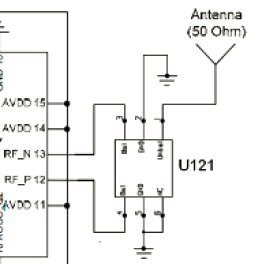
According to the app note, this integrated part is only 0.5dB worse than using another balun with integrated matching but no filtering. It’s 1.5dBm worse than the discrete circuit used on many CC430 eval boards:
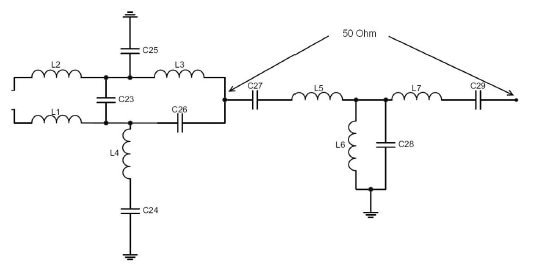
My lab testing comparing the discrete circuit with the '0915 agreed perfectly with the app note showing a 1.5dBm difference.
I have been testing the ‘0915 with the 0868AT43A0020 chip antenna. The entire antenna and matching stub take up only 8 x 10 mm of board space. In my testing, this appears to be 6 dB worse than a quarter-wave monopole antenna. It is also more sensitive than a monopole to detuning in close proximity to a human body. The 915 MHz ISM band wavelength is 33cm, so it is impressive that antenna 1 cm in size works at all.
Based on free-space loss only, it should be possible to get 10km range at the lower data rates using the CC430. TI has a great video demonstrating testing the CC1120, which has the same radio as the CC430 but with slightly better sensitivity, with rubber ducks on a link across Oslo.

The link ran 7km with 28 dB of link margin. They don’t tell us the frequency or data rate, but based on the path cost at 7km and the -90dBm RSSI, it must be 433MHz or 170MHz.
If you need even more range, LSR makes an amplified 915MHz module based on the CC11xx series radio.
CC430 supports data rates up to 500kbps, obviously with higher SNR required than for lower rates. It is amazing what you can do with a $3 processor/radio, a $0.54 balun, a $0.33 antenna, and less than a square inch of board real estate.