element14 Community
element14 Community
    Register Log In
  • Site
  • Search
  • Log In Register
  • Community Hub
    Community Hub
    • What's New on element14
    • Feedback and Support
    • Benefits of Membership
    • Personal Blogs
    • Members Area
    • Achievement Levels
  • Learn
    Learn
    • Ask an Expert
    • eBooks
    • element14 presents
    • Learning Center
    • Tech Spotlight
    • STEM Academy
    • Webinars, Training and Events
    • Learning Groups
  • Technologies
    Technologies
    • 3D Printing
    • FPGA
    • Industrial Automation
    • Internet of Things
    • Power & Energy
    • Sensors
    • Technology Groups
  • Challenges & Projects
    Challenges & Projects
    • Design Challenges
    • element14 presents Projects
    • Project14
    • Arduino Projects
    • Raspberry Pi Projects
    • Project Groups
  • Products
    Products
    • Arduino
    • Avnet & Tria Boards Community
    • Dev Tools
    • Manufacturers
    • Multicomp Pro
    • Product Groups
    • Raspberry Pi
    • RoadTests & Reviews
  • About Us
  • Store
    Store
    • Visit Your Store
    • Choose another store...
      • Europe
      •  Austria (German)
      •  Belgium (Dutch, French)
      •  Bulgaria (Bulgarian)
      •  Czech Republic (Czech)
      •  Denmark (Danish)
      •  Estonia (Estonian)
      •  Finland (Finnish)
      •  France (French)
      •  Germany (German)
      •  Hungary (Hungarian)
      •  Ireland
      •  Israel
      •  Italy (Italian)
      •  Latvia (Latvian)
      •  
      •  Lithuania (Lithuanian)
      •  Netherlands (Dutch)
      •  Norway (Norwegian)
      •  Poland (Polish)
      •  Portugal (Portuguese)
      •  Romania (Romanian)
      •  Russia (Russian)
      •  Slovakia (Slovak)
      •  Slovenia (Slovenian)
      •  Spain (Spanish)
      •  Sweden (Swedish)
      •  Switzerland(German, French)
      •  Turkey (Turkish)
      •  United Kingdom
      • Asia Pacific
      •  Australia
      •  China
      •  Hong Kong
      •  India
      •  Korea (Korean)
      •  Malaysia
      •  New Zealand
      •  Philippines
      •  Singapore
      •  Taiwan
      •  Thailand (Thai)
      • Americas
      •  Brazil (Portuguese)
      •  Canada
      •  Mexico (Spanish)
      •  United States
      Can't find the country/region you're looking for? Visit our export site or find a local distributor.
  • Translate
  • Profile
  • Settings
Publications
  • Learn
  • More
Publications
Blog Light communication with corner-cube reflector design use less power, provide faster data transfer
  • Blog
  • Documents
  • Events
  • Files
  • Members
  • Mentions
  • Sub-Groups
  • Tags
  • More
  • Cancel
  • New
Join Publications to participate - click to join for free!
  • Share
  • More
  • Cancel
Group Actions
  • Group RSS
  • More
  • Cancel
Engagement
  • Author Author: Catwell
  • Date Created: 3 May 2012 4:16 PM Date Created
  • Views 513 views
  • Likes 1 like
  • Comments 1 comment
  • research
  • industry
  • hmi
  • on_campus
  • light
  • Design
  • cabeatwell
  • prototyping
  • wireless
  • university
  • innovation
  • communication
Related
Recommended

Light communication with corner-cube reflector design use less power, provide faster data transfer

Catwell
Catwell
3 May 2012

image


Light communication is nothing new (see the Fraunhofer Institute’s VLC system), but new advancements are making technologies such as free-space retroreflectors more power, efficient, as well as giving them an over-all boost in speed. One of the major draw-backs of using free-space optical communication systems, on space-craft for example, is that they require a sizable power supply to transmit data over significant distances and space for those is often limited.


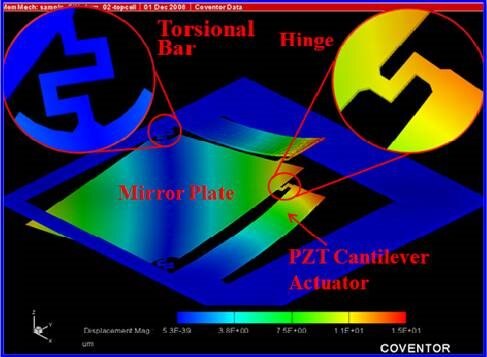
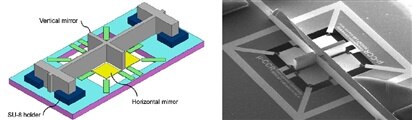
This is where CCR’s (Corner Cube Retroreflectors) become handy. Light can be emitted from a base station that has no power constraints, and the CCR can ‘bounce’ light back to the source with little scattering. They function by using two vertical separately angled mirrors and one horizontal that together form a concaved cube which pulses light from the source to the hub resulting in an ‘on’ state and diverts the light using a piezoelectric cantilever to redirect the horizontal mirror which creates an ‘off’ state. However, they too have their draw-backs in terms of the high-voltage needed to redirect the (off) light-source, but a team of engineers from Kwangwoon University in Seoul have tackled the voltage problem with the help of MEMS (Micro Electrical Mechanical Systems) technology.
 

image

image

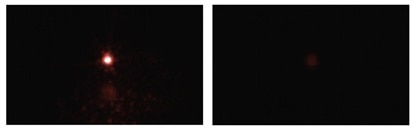
(Top left) Concept of CCR unit (top right) tunneling microscope image (bottom left) CCR on state (bottom right) CCR off state (via J. Park, et al. Copyright 2012 IOP Publishing Ltd)


The teams CCR design uses perfectly aligned silicon mirrors fabricated using a double SOI (Silicon on Insulation) wafer with an anisotropic KOH (potassium hydroxide) wet etching technique which makes them almost perfectly flat. The team then micro-fabricated a lead zirconate titanate (PZT) piezoelectric cantilever that runs on a voltage of only 5 volts to actuate the horizontal mirror. The reduction in overall voltage is attributed to the almost perfect alignment of the specially designed mirrors. In addition to being more accurate and energy conservative, they can also be outfitted with sensors as well as CMOS circuitry giving them additional micro-optical systems applications such as coded data communications for the military. While the team's new CCR design is extremely efficient over previous iterations, it still has its faults. Its range is limited due to a slight curvature in the horizontal mirror, but the engineers state that the problem will be overcome through ‘optimization of the material selection and the process conditions.'


Cabe

http://twitter.com/Cabe_e14

  • Sign in to reply
  • DAB
    DAB over 13 years ago

    Hi Cabe,


    FYI, they could increase their range if they pass the input light through a re-collumator so that they correct for the atmospheric diffraction.

    They could also use a TEM11 mode, which has less divergence over long ranges.

    A reconfigurable mirror system could also work, as it would maintain a flat surface for the mirror and it could do some of the diffraction correction.


    They may get some benefit from different materials, but I think they would be better off looking at their system issues and build in some autocorrection.  Reflection gain will only help so far, after that you need to do other techniques.


    Just a thought,

    DAB

    • Cancel
    • Vote Up 0 Vote Down
    • Sign in to reply
    • More
    • Cancel
element14 Community

element14 is the first online community specifically for engineers. Connect with your peers and get expert answers to your questions.

  • Members
  • Learn
  • Technologies
  • Challenges & Projects
  • Products
  • Store
  • About Us
  • Feedback & Support
  • FAQs
  • Terms of Use
  • Privacy Policy
  • Legal and Copyright Notices
  • Sitemap
  • Cookies

An Avnet Company © 2025 Premier Farnell Limited. All Rights Reserved.

Premier Farnell Ltd, registered in England and Wales (no 00876412), registered office: Farnell House, Forge Lane, Leeds LS12 2NE.

ICP 备案号 10220084.

Follow element14

  • X
  • Facebook
  • linkedin
  • YouTube