element14 Community
element14 Community
    Register Log In
  • Site
  • Search
  • Log In Register
  • Community Hub
    Community Hub
    • What's New on element14
    • Feedback and Support
    • Benefits of Membership
    • Personal Blogs
    • Members Area
    • Achievement Levels
  • Learn
    Learn
    • Ask an Expert
    • eBooks
    • element14 presents
    • Learning Center
    • Tech Spotlight
    • STEM Academy
    • Webinars, Training and Events
    • Learning Groups
  • Technologies
    Technologies
    • 3D Printing
    • FPGA
    • Industrial Automation
    • Internet of Things
    • Power & Energy
    • Sensors
    • Technology Groups
  • Challenges & Projects
    Challenges & Projects
    • Design Challenges
    • element14 presents Projects
    • Project14
    • Arduino Projects
    • Raspberry Pi Projects
    • Project Groups
  • Products
    Products
    • Arduino
    • Avnet & Tria Boards Community
    • Dev Tools
    • Manufacturers
    • Multicomp Pro
    • Product Groups
    • Raspberry Pi
    • RoadTests & Reviews
  • About Us
  • Store
    Store
    • Visit Your Store
    • Choose another store...
      • Europe
      •  Austria (German)
      •  Belgium (Dutch, French)
      •  Bulgaria (Bulgarian)
      •  Czech Republic (Czech)
      •  Denmark (Danish)
      •  Estonia (Estonian)
      •  Finland (Finnish)
      •  France (French)
      •  Germany (German)
      •  Hungary (Hungarian)
      •  Ireland
      •  Israel
      •  Italy (Italian)
      •  Latvia (Latvian)
      •  
      •  Lithuania (Lithuanian)
      •  Netherlands (Dutch)
      •  Norway (Norwegian)
      •  Poland (Polish)
      •  Portugal (Portuguese)
      •  Romania (Romanian)
      •  Russia (Russian)
      •  Slovakia (Slovak)
      •  Slovenia (Slovenian)
      •  Spain (Spanish)
      •  Sweden (Swedish)
      •  Switzerland(German, French)
      •  Turkey (Turkish)
      •  United Kingdom
      • Asia Pacific
      •  Australia
      •  China
      •  Hong Kong
      •  India
      • Japan
      •  Korea (Korean)
      •  Malaysia
      •  New Zealand
      •  Philippines
      •  Singapore
      •  Taiwan
      •  Thailand (Thai)
      • Vietnam
      • Americas
      •  Brazil (Portuguese)
      •  Canada
      •  Mexico (Spanish)
      •  United States
      Can't find the country/region you're looking for? Visit our export site or find a local distributor.
  • Translate
  • Profile
  • Settings
Publications
  • Learn
  • More
Publications
Blog Living Fuel-Cell, Cockroach Power
  • Blog
  • Documents
  • Events
  • Files
  • Members
  • Mentions
  • Sub-Groups
  • Tags
  • More
  • Cancel
  • New
Join Publications to participate - click to join for free!
  • Share
  • More
  • Cancel
Group Actions
  • Group RSS
  • More
  • Cancel
Engagement
  • Author Author: Catwell
  • Date Created: 9 Feb 2012 9:36 PM Date Created
  • Views 554 views
  • Likes 0 likes
  • Comments 0 comments
  • insect
  • research
  • alternative_energy
  • engineering_on_friday
  • industry
  • on_campus
  • Design
  • cabeatwell
  • prototyping
  • fuel_cell
  • university
  • power
  • energy
  • innovation
Related
Recommended

Living Fuel-Cell, Cockroach Power

Catwell
Catwell
9 Feb 2012

image

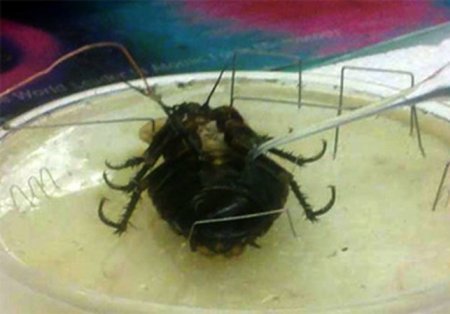
The cockroach fuel-cell volunteer (via ACS Publications)


The living-cell battery from the Matrix movies is real, but not for us humans.


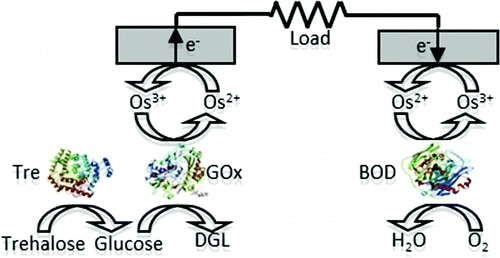
Scientist Daniel Scherson and his team from Case Western Reserve University, Ohio, have take to immobilizing insects and turning them into living fuel-cells. Using a "False Death's Head Cockroach," also know as a discoidalis,  the team was able to insert electrodes made of thin carbon fibers sealing in a glass capillary tube into incisions made in the insect. The biofuel cell using the roach's "trehalose" sugar as a fuel mixed with oxygen to generate electricity. The outcome maxed out at approximately 55 μW/cm2 at 0.2 V.
 

image

The Trehalose based fuel-cell. "bienzymatic trehalase|glucose oxidase trehalose anode and a bilirubin oxidase dioxygen cathode using Os complexes grafted to a polymeric backbone as electron relays was designed and constructed." (via ACS Publications)


Although the glass tube,  two pins through the pronotum, two more pins the posterior of the abdomen, and a series of staples to hold the cockroach down did no significant damage to the insect's critical organs, we can all assume it was not a pleasant experience for our insect friend. There may be a reprieve for the living creatures on this project. The team was able to achieve similar results with the same procedure on a Shiitake Mushrooms.


The team stated that the goal is to power micro and nano devices with a semi-recharging battery. (ie: The insect eats, and then recharges its core, so to speak.) Research funding was provided by the National Science Foundation. Read about the whole project after the link.


It is a shame that creatures have to suffer so much for our benefit and gain.


Cabe

http://twitter.com/Cabe_e14

  • Sign in to reply
element14 Community

element14 is the first online community specifically for engineers. Connect with your peers and get expert answers to your questions.

  • Members
  • Learn
  • Technologies
  • Challenges & Projects
  • Products
  • Store
  • About Us
  • Feedback & Support
  • FAQs
  • Terms of Use
  • Privacy Policy
  • Legal and Copyright Notices
  • Sitemap
  • Cookies

An Avnet Company © 2026 Premier Farnell Limited. All Rights Reserved.

Premier Farnell Ltd, registered in England and Wales (no 00876412), registered office: Farnell House, Forge Lane, Leeds LS12 2NE.

ICP 备案号 10220084.

Follow element14

  • X
  • Facebook
  • linkedin
  • YouTube