


(Left) Tongue Drive System retainer. (Right) iPhone rig for wireless control. (via Georgia Tech & Maysam Ghovanloo)
A mouth based interface allows users to drive an electric wheelchair with only their tongue. Dubbed the "Tongue Drive System," (TDS) it was developed by researchers at the Georgia Institute of Technology for those with "high-level spinal cord injuries" or anyone with the inability to move their limbs. From controlling a wheelchair to a cursor on a screen, the TDS gives a welcomed interface system for those in need.
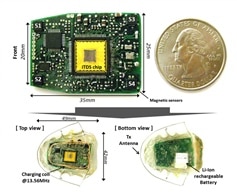
Retainer circuit (via Georgia Tech & Maysam Ghovanloo)
The device is entirely housed in a retainer, and it is unnoticeable from the outside. The TDS works by detecting a magnet, attached to the user's tongue with a tongue piercing, via four magnetic field sensors at the four corners of the retainer. The sensors detect position and wirelessly send the information to an iOS device (iPod or iPhone in the demonstrations) where it is interpreted as a cursor action or movement for the wheelchair. The retainer also houses a lithium-ion battery and induction coil for charging. After the retainer is molded for the particular user, it is encased in a vacuum-sealed dental-acrylic coating to protect from water. Additionally, a "sip-n-puff" straw sensor can work in tandem with the TDS, providing an additional switch.
Prior versions of the system used a headset that needed constant calibration. "Because the dental appliance is worn inside the mouth and molded from dental impressions to fit tightly around an individual’s teeth with clasps, it is protected from these types of disturbances," said Maysam Ghovanloo, associate professor and project lead at Georgia Tech.
Trials are being conducted at the Atlanta Shepherd Center and the Rehabilitation Institute of Chicago, where 11 volunteers with high-level spinal cord injuries have received a clinical tongue piercing for the magnet. During the two test sessions per week, for six weeks, the users are showing rapid improvement with controlling the system. The Georgia Tech team believes that patients will become more efficient with the TDS over time. This may become a life changing technology. I hope the trials lead to more funding on the project.
Ghovanloo showed the TDS at the IEEE International Solid-State Circuit Conference on February 20, 2012. The project is funded by the National Institute of Health, the National Science Foundation, and the Christopher and Dana Reeve Foundation.
Cabe