element14 Community
element14 Community
    Register Log In
  • Site
  • Search
  • Log In Register
  • Community Hub
    Community Hub
    • What's New on element14
    • Feedback and Support
    • Benefits of Membership
    • Personal Blogs
    • Members Area
    • Achievement Levels
  • Learn
    Learn
    • Ask an Expert
    • eBooks
    • element14 presents
    • Learning Center
    • Tech Spotlight
    • STEM Academy
    • Webinars, Training and Events
    • Learning Groups
  • Technologies
    Technologies
    • 3D Printing
    • FPGA
    • Industrial Automation
    • Internet of Things
    • Power & Energy
    • Sensors
    • Technology Groups
  • Challenges & Projects
    Challenges & Projects
    • Design Challenges
    • element14 presents Projects
    • Project14
    • Arduino Projects
    • Raspberry Pi Projects
    • Project Groups
  • Products
    Products
    • Arduino
    • Avnet & Tria Boards Community
    • Dev Tools
    • Manufacturers
    • Multicomp Pro
    • Product Groups
    • Raspberry Pi
    • RoadTests & Reviews
  • About Us
  • Store
    Store
    • Visit Your Store
    • Choose another store...
      • Europe
      •  Austria (German)
      •  Belgium (Dutch, French)
      •  Bulgaria (Bulgarian)
      •  Czech Republic (Czech)
      •  Denmark (Danish)
      •  Estonia (Estonian)
      •  Finland (Finnish)
      •  France (French)
      •  Germany (German)
      •  Hungary (Hungarian)
      •  Ireland
      •  Israel
      •  Italy (Italian)
      •  Latvia (Latvian)
      •  
      •  Lithuania (Lithuanian)
      •  Netherlands (Dutch)
      •  Norway (Norwegian)
      •  Poland (Polish)
      •  Portugal (Portuguese)
      •  Romania (Romanian)
      •  Russia (Russian)
      •  Slovakia (Slovak)
      •  Slovenia (Slovenian)
      •  Spain (Spanish)
      •  Sweden (Swedish)
      •  Switzerland(German, French)
      •  Turkey (Turkish)
      •  United Kingdom
      • Asia Pacific
      •  Australia
      •  China
      •  Hong Kong
      •  India
      • Japan
      •  Korea (Korean)
      •  Malaysia
      •  New Zealand
      •  Philippines
      •  Singapore
      •  Taiwan
      •  Thailand (Thai)
      • Vietnam
      • Americas
      •  Brazil (Portuguese)
      •  Canada
      •  Mexico (Spanish)
      •  United States
      Can't find the country/region you're looking for? Visit our export site or find a local distributor.
  • Translate
  • Profile
  • Settings
Publications
  • Learn
  • More
Publications
Blog Marlow Releases Thermoelectric Energy Harvesting Modules
  • Blog
  • Documents
  • Events
  • Files
  • Members
  • Mentions
  • Sub-Groups
  • Tags
  • More
  • Cancel
  • New
Join Publications to participate - click to join for free!
  • Share
  • More
  • Cancel
Group Actions
  • Group RSS
  • More
  • Cancel
Engagement
  • Author Author: gervasi
  • Date Created: 6 Nov 2011 7:00 PM Date Created
  • Views 599 views
  • Likes 0 likes
  • Comments 0 comments
  • alternative_energy
  • energy_harvesting
Related
Recommended

Marlow Releases Thermoelectric Energy Harvesting Modules

gervasi
gervasi
6 Nov 2011

This summer at ESC Chicago Marlow Industries had a display of their thermal engergy harvesting module prototypes in which an energy harvester powered a clock using the heat from a small space heater.  Marlow is releasing these products to production and making them available in single-piece quantities for $295.  (To see another example of thermoelectric harvesting, Jeri Ellsworth has a very brief demo of running an HP16C of heat from her body at the very end of her video on energy harvesting.) The energy harvesters use a Peltier junction.


When I atteneded ESC, I had recently used a Peltier thermoelectric cooler (TEC) to cool an optical detector and dealt with the issue of supplying power to it efficiently at a low voltage.  The reverse process, known as the Seebeck Effect, involves harvesting energy from a temperate difference across a Peltier junction.  It presents the reverse of the challenge I had driving a low voltage efficiently: Turning the low-voltage energy from the Peltier junction into useful energy.image
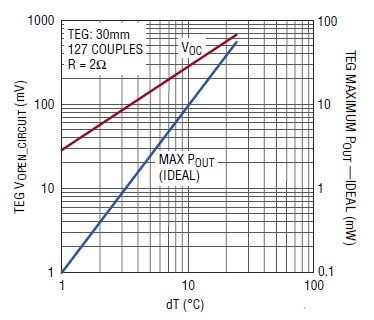
 

A Peltier junction looks like a voltage source that varies with temperature with an internal resistance of a few ohms.  The voltage at a 10 degree temperature difference is around 100mV.  You could put the Peltier devices in series to get a higher voltage, but that also means the internal resistances add in series too.  For maximum efficiency, you need a single Peltier junction driving a load whose resistance equals the resistance of the Peltier junction.  See the chart to the right from Linear Technology showing the voltage versus temperature different with no load and with the optimal load.


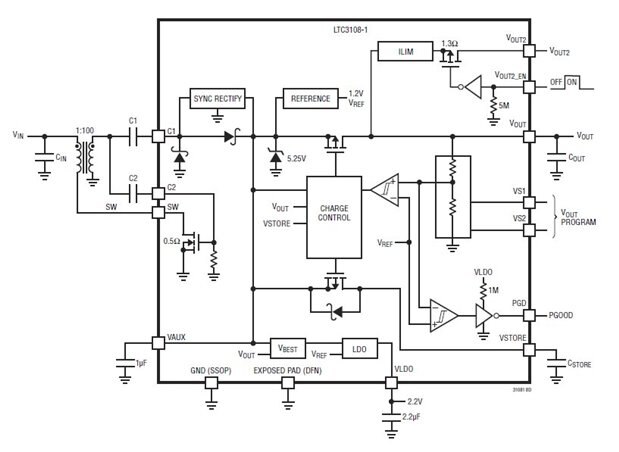
A boost converter with a transformer at the input can be used to boost these very low voltages to something usable.  This is similar to a regular boost converter but with a transformer at the source instead of an inductor.
 

image

From Linear Technology LTC3108 Datasheet -  (Click to enlarge)


The modules I saw from Marlow Industries have the boost circuit built in.  They provide a 2.2V output and a jumper-selectable 2.35V, 3.3V, 4.1V, or 5V output.  They have integrated thermocouples that provide a temperature indication on both sides of the junction.  There is a place to connect battery or BFC that is charged up to 5.25V and used to power the system during periods when there is not enough power capture by thermal harvesting.  You can order the modules configured to be mounted to pipes or solid surfaces.


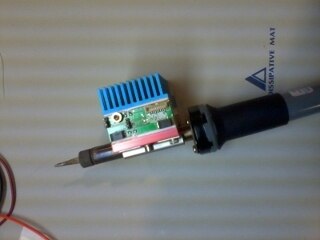
Marlow provided a sample of the pipe-to-air configuration for testing.  I found the module’s voltage came up with no load at only a slight temperature increase.  Mounted to a hot water pipe, I was able to get around 0.5mA at 5V before the output started loading down.  As a best case test, I heated the pipe side with an old open-loop soldering iron set to low heat.  I cooled the air heat sink side with a fan on my bench.  In this condition, the module was able to maintain 5V into a 4.7k resistor, i.e. 5mW output.  I tried to drive a 1.2k load (i.e. 20mW out), but the load always pulled the voltage down unless I heated the module excessively with the fan right up against the air heat sink.  The engineers at Marlow rightly laughed at this test setup, but it did give an indication of the maximum power the module could ever provide.image
 

Thermoelectric energy harvesting is a great way to get a tiny bit of power in locations where you have a heat differential.  It is not a significant source of power in terms of alternative energy, but it is a good thing for the environment if it eliminates batteries or the need to run cables to inconvenient locations.

  • Sign in to reply
element14 Community

element14 is the first online community specifically for engineers. Connect with your peers and get expert answers to your questions.

  • Members
  • Learn
  • Technologies
  • Challenges & Projects
  • Products
  • Store
  • About Us
  • Feedback & Support
  • FAQs
  • Terms of Use
  • Privacy Policy
  • Legal and Copyright Notices
  • Sitemap
  • Cookies

An Avnet Company © 2026 Premier Farnell Limited. All Rights Reserved.

Premier Farnell Ltd, registered in England and Wales (no 00876412), registered office: Farnell House, Forge Lane, Leeds LS12 2NE.

ICP 备案号 10220084.

Follow element14

  • X
  • Facebook
  • linkedin
  • YouTube