


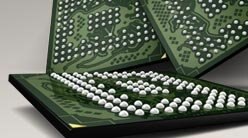
Phase-change multi-chip packaged memory concept (via Micron)
Micron has announced the availability of their newly minted phase-change memory (PCM) for mobile devices. This makes their 45nm PCM the first ever available for mobile device manufacturers to implement into the next gen of tablets and mobile phones. The benefits of PCM over flash memory are almost night and day. While typical NAND-based flash memory makes use of traditional silicon and uses floating-gate transistors with a read/write of 1 bit, PCM has an access rate of 166MT/s (Mega-transfers per second) through a process called tunnel injection (for writing only).
Erasing NAND-based memory is done in blocks or chunks of information at a time (called tunnel release) and affects the flash over time making it unstable and eventually ultimately failing all together after usually 100,000 program-erase cycles. PCM, on the other hand, takes advantage of chalcogenide glass (an alloy comprised of germanium, antimony and tellurium commonly found in CD/DVD-RW’s) which changes states when electricity is applied and produces heat which turns the glass from crystalline to amorphous. The phase change represents a 1 or 0 respectively when the material is in either state. It has an advantage over NAND in that it doesn’t require ‘blocks’ of information to be erased in order to re-write data.
A greater advantage of PCMs over their flash counterpart is that they can retain information over longer periods of time (thought to be 300 years or more), while the gates used in flash tend to ‘leak’ electrons which results in data corruption. PCM is not without its flaws. PCMs have trouble with heat variances which tends to delete data altogether (unknown at this time how Micron was able to solve this problem), phase-change memory is still faster and more resistant to power-loss.
Microns new PCM-based multi-chip packaged memory actually combines both phase-change and DRAM into one package, which gives the user the best of both worlds with both speed and reliability and features a 45nm 1 GB PCM module along with a 512Mb LPDDR2 chip powered with 1.8 volts. It has an operating temperature range of -25C to +85C which is in the tolerable range of for use most anywhere on the planet (unless you frequent places like Antarctica or Tanzania). So far Intel’s Mobile and Communications Group is looking into implementing Micron’s new PCM-based memory into their future mobile devices, and other companies expected to follow suit.
Cabe