


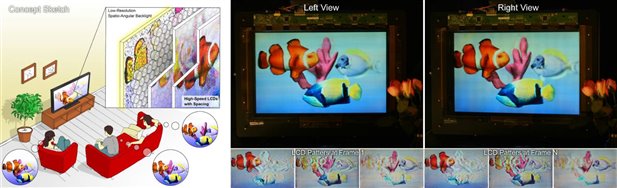
Tensor Display concept (via MIT)
Watching movies on an IMAX 3D screen is impressive, leaving the home theater lackluster in comparison (unless you own an $113,000 US B&O 103in 3D TV). Researchers from MIT’s Media Lab are looking to change that by getting rid of the glasses needed to view our favorite HD movies in three dimensions, introducing ‘Tensor Displays’. Their 3D technology is being touted as ‘producing images as bright as conventional TV’s without the need for glasses to view media in 3D’. In addition to the ‘spectacles-free’ advancement, persons sitting at different viewing angles will see different perspectives of the images being displayed. For example, a person viewing a movie about fish while sitting lower than the screen might see the bottom of a boat on top of the water while another individual viewing head-on will not be able to see it which is known as ‘multi-view display’ technology.
To accomplish this feat, the research team developed their Tensor Display (compressive light-field display) by compressing 4 layers of LCD’s on top of one another that all flicker at a different rates using image-encoding algorithms (like those found in DVD and Blu-ray players). This process tricks the eye into thinking it is looking at a 3D image without a noticeable refresh rate. The actual display layers consist of a uniform/ directional backlight (consisting of a lenslet array mounted on an LCD screen) with a high-speed LCD screen positioned over the backlight. An LCD lens panel is then mounted over the first two, which acts as a filter of sorts, and a fourth and final high-speed LCD is then positioned on top of the previous three.
The display’s driver-electronics (along with a GPU) are positioned at the top of the screens aluminum plate frame which uses a railing/clip system to hold the respective screens at a precise distance relative to one another. In order for people to watch 3D movies on Media Lab’s 3D Tensor Displays, movie producers will have to film in multiple angles for just one scene alone (think around 35 different angles) in order to bring their new system to life so don’t expect to see these for sale any time soon. The research team does state, however, that further refinement of the displays could result in commercialization within the next 5 years where it could be implemented into the video game market (as it is easier to produce different scene angles over movies).
Cabe