


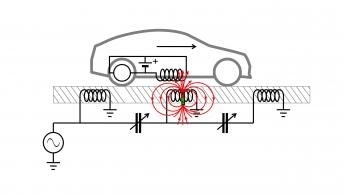
Road power faux-schematic (via Stanford University)
MIT is again at the heart of another technological advancement. This time Stanford University is taking the MIT development to another level, providing power to electrical vehicles via embedded wireless power transfer coils in roadways.
. Originally it was for charging EVs while parked. Stanford associate professor Shanhui Fan wants to take the MIT tech to 10kWs at a distance of 6.5 feet. Fan explained his goal, "Our vision is that you’ll be able to drive onto any highway and charge your car. Large-scale deployment would involve revamping the entire highway system and could even have applications beyond transportation.”
Fan's system would place copper coils in the road surface that are turned to resonate with another coil placed inside the moving EV. With the road coils so close together, there will always be a constant power connection to the road despite how fast one drivers. Postdoctoral scholars Xiaofang Yu and Sunil Sandhu discovered that at a 90-degree angle, attached to a metal plate, a copper coil could transfer 10kW at 6.5 feet. Proving the possibility is one hurdle accomplished. Using magnetic resonance coupling, Fan estimates that an energy transfer efficiency of 97% would be needed to make it useful. Even for magnetic coupling, that efficiency requirement is a tall order. When it comes to technological advancements, always set the bar high.
The Korea Advanced Institute of Science and Technology (KAIST) already has Fan beat. Their road power system is already in operation on the school campus. Although they have only a 80% transfer efficiency, they are applying 30kW to the source. Perhaps the Stanford team should take some queues from KAIST. There is always Japan's EV road rescue service as a back up.
Cabe