


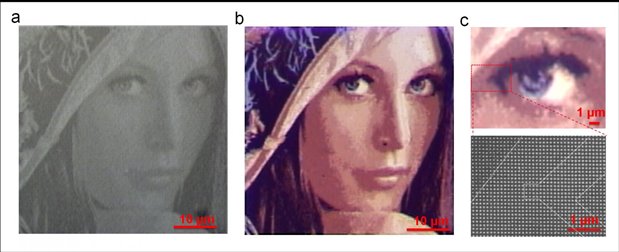
(a) nanostructure base image (b) metal is added to the nano-structure, colours observed (c) enlarged image of the eye's corner (via A*STAR & Nature Technology)
Researchers from A*STAR's Institute of Materials Research and Engineering in Singapore have developed an innovative new way to create images in a much higher resolution. Current laserjet and inkjet printers can produce images in full color at up to 10,000 dots per inch (dpi). The researchers claim that their new method would have a potential limit of creating images at up to 100,000dpi.
The work is said to have been derived from inspiration through the way stained glass is traditionally created. Stained glass is made by mixing tiny fragments of metal into the glass which scatter light passing through it and give the stained glass its color. Similarly, researchers used nanotechnology to precisely pattern metal nanostructures together and created a surface to reflect light of specific colors to create color images.
“Instead of using different dyes for different colours, we encoded colour information into the size and position of tiny metal disks. These disks then interacted with light through the phenomenon of plasmon resonances,” said Dr Joel Yang, the project leader of the research. With the nanostructures placed accordingly, placing the ultra thin metal film over the picture made all the “encoded” colors seem to all appear at once.
The new technique is much more similar to lithography than traditional printing but could possibly be the foundation for the future of the way we create images. Furthermore, researchers stated the technology could be further developed for use in high-resolution reflective color displays and high density optical data storage. Who would have guessed something as old as stained glass would have inspired a new way to create the most high resolution images to date.
Cabe