


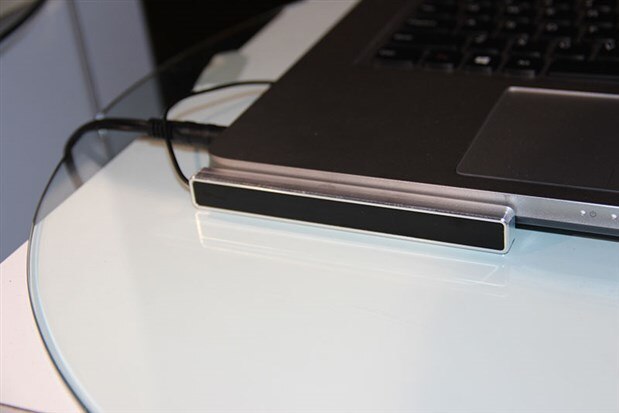
Neonode's MultiSensing "proximity sensor." Placed anywhere, the surfaces in range become touch HMIs. (via Neonode)
It has become clear over the years that human-machine interfaces are moving from the once highly regarded touch interface to something more along the lines of touch-less. This has given rise to wildly interactive devices such as the Kinect, the Playstation move, and the recent Leap Motion Controller that will be released later this year. Now, Neonode has stepped into the fray by introducing a novel approach to proximity sensing technology.
Neonode designs and develops high performance touch solutions for a wide range of applications such as mobile computing, smartphones, toys, and gaming consoles using its patented zForce technology and its most recently trademarked MultiSensing technology. Now, they have decided to reinvent and reintroduce a new way to interact with our everyday devices by ditching the touch screens and packing on their MultiSensing proximity sensor.
The new design incorporates infrared-emitting bars that create a near two-dimensional interactive surface where the touchless exchange takes place. Neonode first presents a computing solution using a rectangular infrared bar that acts like a virtual drawing pad as your finger interrupts the light emitted within the bar. Another interesting concept involves integrating their proximity sensors into the steering wheel of a car. This would allow one to navigate through menus, change radio stations, etc. through pre-defined gestures triggered by moving your hand across the steering wheel’s surface. Neonode already claims to be in talks with several very interested car manufacturers, so stay tuned for more news on that end. The last of their new concepts involves strapping an infrared bar around the bezel of a smartphone. The interfacing of smartphones is always a hot topic, and this technique hopes to stretch a phone’s capabilities by removing the need to touch the phone for certain applications. Neonode’s website offers us a taste of this by showing someone play a racing game and subsequently laying down a drum beat by merely moving their hands around the phone’s outer edge.
Though this technology can have a remarkable impact to mobile computing and gaming, it’s relevance to smartphones is questionable until size and power issues are dissolved. Nonetheless, Neonode does as it sets out to do by offering innovative solutions that are moving us closer to a touch-less interface world. The control is now in our hands.
Cabe