element14 Community
element14 Community
    Register Log In
  • Site
  • Search
  • Log In Register
  • Community Hub
    Community Hub
    • What's New on element14
    • Feedback and Support
    • Benefits of Membership
    • Personal Blogs
    • Members Area
    • Achievement Levels
  • Learn
    Learn
    • Ask an Expert
    • eBooks
    • element14 presents
    • Learning Center
    • Tech Spotlight
    • STEM Academy
    • Webinars, Training and Events
    • Learning Groups
  • Technologies
    Technologies
    • 3D Printing
    • FPGA
    • Industrial Automation
    • Internet of Things
    • Power & Energy
    • Sensors
    • Technology Groups
  • Challenges & Projects
    Challenges & Projects
    • Design Challenges
    • element14 presents Projects
    • Project14
    • Arduino Projects
    • Raspberry Pi Projects
    • Project Groups
  • Products
    Products
    • Arduino
    • Avnet & Tria Boards Community
    • Dev Tools
    • Manufacturers
    • Multicomp Pro
    • Product Groups
    • Raspberry Pi
    • RoadTests & Reviews
  • About Us
  • Store
    Store
    • Visit Your Store
    • Choose another store...
      • Europe
      •  Austria (German)
      •  Belgium (Dutch, French)
      •  Bulgaria (Bulgarian)
      •  Czech Republic (Czech)
      •  Denmark (Danish)
      •  Estonia (Estonian)
      •  Finland (Finnish)
      •  France (French)
      •  Germany (German)
      •  Hungary (Hungarian)
      •  Ireland
      •  Israel
      •  Italy (Italian)
      •  Latvia (Latvian)
      •  
      •  Lithuania (Lithuanian)
      •  Netherlands (Dutch)
      •  Norway (Norwegian)
      •  Poland (Polish)
      •  Portugal (Portuguese)
      •  Romania (Romanian)
      •  Russia (Russian)
      •  Slovakia (Slovak)
      •  Slovenia (Slovenian)
      •  Spain (Spanish)
      •  Sweden (Swedish)
      •  Switzerland(German, French)
      •  Turkey (Turkish)
      •  United Kingdom
      • Asia Pacific
      •  Australia
      •  China
      •  Hong Kong
      •  India
      • Japan
      •  Korea (Korean)
      •  Malaysia
      •  New Zealand
      •  Philippines
      •  Singapore
      •  Taiwan
      •  Thailand (Thai)
      • Vietnam
      • Americas
      •  Brazil (Portuguese)
      •  Canada
      •  Mexico (Spanish)
      •  United States
      Can't find the country/region you're looking for? Visit our export site or find a local distributor.
  • Translate
  • Profile
  • Settings
Publications
  • Learn
  • More
Publications
Blog New frequency comb makes mobile device communication faster but can't style hair
  • Blog
  • Documents
  • Events
  • Files
  • Members
  • Mentions
  • Sub-Groups
  • Tags
  • More
  • Cancel
  • New
Join Publications to participate - click to join for free!
  • Share
  • More
  • Cancel
Group Actions
  • Group RSS
  • More
  • Cancel
Engagement
  • Author Author: Eavesdropper
  • Date Created: 15 Mar 2012 6:08 PM Date Created
  • Views 671 views
  • Likes 1 like
  • Comments 2 comments
  • research
  • industry
  • on_campus
  • eavesdropper
  • university
  • innovation
  • communication
Related
Recommended

New frequency comb makes mobile device communication faster but can't style hair

Eavesdropper
Eavesdropper
15 Mar 2012

image

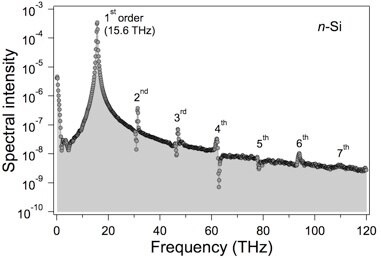
Frequency comb observed in the Fourier transform spectrum (via the University of Pittsburgh)


Our present communications devices, such as cellphones, rely on specific frequencies (usually in the GHz Bandwidth) located in the electromagnetic radiation light spectrum to send and receive information. This frequency range is limited in the speed at which information can be carried (in the form of a sine wave traveling between the very low frequency (VLF) and microwave light spectrum). A recent breakthrough, however, can make our mobile device signal a thousand times faster through the use of a crystal and creative thinking.


Professor Hrvoje Petek from the University of Pittsburgh and Professor Muneaki Hase from the University of Tsukuba have collaborated to create what’s known as a ‘frequency comb’, which is a separation of a single color in the light spectrum into spectral lines that can reach a frequency into the terahertz region. According to Professor Petek, they could do this by using a concentrated laser pulse to ‘excite the atomic motions in a semiconductor silicon crystal’. Generation of the terahertz signal is only realised by harnessing this motion.


The team then measured the reflection of the laser pulse oscillation which measured at the 15.6THz range.That’s ‘mad scientist' for shooting a laser at a crystal and measuring the frequency generated by each line in the projected comb. It’s at this point that something magical happened as the oscillation also changed the refraction and absorption of the light; multiplying the comb strand frequencies to over 100THz! Sending and receiving information in the space between the microwave and infrared light spectrum would make 4G LTE look like snail racing a Ferrari.


Professor Petek boasted the work of the team, "Although we expected to see the oscillation at 15.6 THz, we did not realize that its excitation could change the properties of silicon in such dramatic fashion... The discovery was both the result of developing unique instrumentation and incisive analysis by the team members.”


Eavesdropper

  • Sign in to reply
  • gervasi
    gervasi over 13 years ago

    If this is like regular RF communication, we want to get rid of those harmonics.  It's scienctifically neat that the harmonics extended into the 100 THz range, but it's clearly something undesirable.  I


    I wonder if this is the first step to THz communication.  We just need to modulate a message signal on to that carrier and if possible surpress the harmonics.  It sounds insane, but we used call anything above 900MHz (the GHz) as if it were something incredibly high tech.  I could have imagined the GHz becoming more popular but not GHz transceiver being implemented in earpieces and all consumer electronics. 

    • Cancel
    • Vote Up 0 Vote Down
    • Sign in to reply
    • More
    • Cancel
  • DAB
    DAB over 13 years ago

    I don't know about combing your hair, but the effects of those frequencies could probably leave you bald.

    Something to think about the next time you make a call. image


    DAB

    • Cancel
    • Vote Up 0 Vote Down
    • Sign in to reply
    • More
    • Cancel
element14 Community

element14 is the first online community specifically for engineers. Connect with your peers and get expert answers to your questions.

  • Members
  • Learn
  • Technologies
  • Challenges & Projects
  • Products
  • Store
  • About Us
  • Feedback & Support
  • FAQs
  • Terms of Use
  • Privacy Policy
  • Legal and Copyright Notices
  • Sitemap
  • Cookies

An Avnet Company © 2026 Premier Farnell Limited. All Rights Reserved.

Premier Farnell Ltd, registered in England and Wales (no 00876412), registered office: Farnell House, Forge Lane, Leeds LS12 2NE.

ICP 备案号 10220084.

Follow element14

  • X
  • Facebook
  • linkedin
  • YouTube