element14 Community
element14 Community
    Register Log In
  • Site
  • Search
  • Log In Register
  • Community Hub
    Community Hub
    • What's New on element14
    • Feedback and Support
    • Benefits of Membership
    • Personal Blogs
    • Members Area
    • Achievement Levels
  • Learn
    Learn
    • Ask an Expert
    • eBooks
    • element14 presents
    • Learning Center
    • Tech Spotlight
    • STEM Academy
    • Webinars, Training and Events
    • Learning Groups
  • Technologies
    Technologies
    • 3D Printing
    • FPGA
    • Industrial Automation
    • Internet of Things
    • Power & Energy
    • Sensors
    • Technology Groups
  • Challenges & Projects
    Challenges & Projects
    • Design Challenges
    • element14 presents Projects
    • Project14
    • Arduino Projects
    • Raspberry Pi Projects
    • Project Groups
  • Products
    Products
    • Arduino
    • Avnet & Tria Boards Community
    • Dev Tools
    • Manufacturers
    • Multicomp Pro
    • Product Groups
    • Raspberry Pi
    • RoadTests & Reviews
  • About Us
  • Store
    Store
    • Visit Your Store
    • Choose another store...
      • Europe
      •  Austria (German)
      •  Belgium (Dutch, French)
      •  Bulgaria (Bulgarian)
      •  Czech Republic (Czech)
      •  Denmark (Danish)
      •  Estonia (Estonian)
      •  Finland (Finnish)
      •  France (French)
      •  Germany (German)
      •  Hungary (Hungarian)
      •  Ireland
      •  Israel
      •  Italy (Italian)
      •  Latvia (Latvian)
      •  
      •  Lithuania (Lithuanian)
      •  Netherlands (Dutch)
      •  Norway (Norwegian)
      •  Poland (Polish)
      •  Portugal (Portuguese)
      •  Romania (Romanian)
      •  Russia (Russian)
      •  Slovakia (Slovak)
      •  Slovenia (Slovenian)
      •  Spain (Spanish)
      •  Sweden (Swedish)
      •  Switzerland(German, French)
      •  Turkey (Turkish)
      •  United Kingdom
      • Asia Pacific
      •  Australia
      •  China
      •  Hong Kong
      •  India
      • Japan
      •  Korea (Korean)
      •  Malaysia
      •  New Zealand
      •  Philippines
      •  Singapore
      •  Taiwan
      •  Thailand (Thai)
      • Vietnam
      • Americas
      •  Brazil (Portuguese)
      •  Canada
      •  Mexico (Spanish)
      •  United States
      Can't find the country/region you're looking for? Visit our export site or find a local distributor.
  • Translate
  • Profile
  • Settings
Publications
  • Learn
  • More
Publications
Blog New satellite aims to chase down and clean up space debris
  • Blog
  • Documents
  • Events
  • Files
  • Members
  • Mentions
  • Sub-Groups
  • Tags
  • More
  • Cancel
  • New
Join Publications to participate - click to join for free!
  • Share
  • More
  • Cancel
Group Actions
  • Group RSS
  • More
  • Cancel
Engagement
  • Author Author: Catwell
  • Date Created: 28 Feb 2012 7:56 PM Date Created
  • Views 659 views
  • Likes 1 like
  • Comments 1 comment
  • research
  • defense
  • test
  • transportation
  • industry
  • hmi
  • robotics
  • robot
  • space
  • embedded
  • Design
  • cabeatwell
  • prototyping
  • measurement
  • sensor
  • aerospace
  • innovation
Related
Recommended

New satellite aims to chase down and clean up space debris

Catwell
Catwell
28 Feb 2012

image

CleanSpace concept drawing (via EPFL)


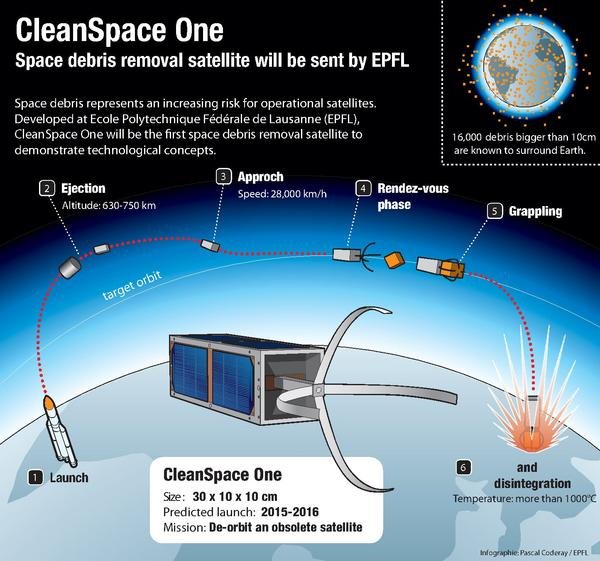
Space is a messy place. According to NASA, it is littered with over ten million pieces of debris orbiting the Earth at a rate of around 36,000 km/h. That junk is potentially hazardous not only to astronauts but can damage or destroy spacecraft and satellites, as well. To combat this problem engineers from the Swiss Space Center at EPFL (Ecole Polytechnique Federale de Lausanne) have designed a satellite that performs a kind of intergalactic housekeeping. Called ‘CleanSpace One’, the satellite finds its target and latches on with a grappling mechanism. Once the garbage is taken hold of, CleanSpace One then de-orbits the Earth and both it and the garbage are harmlessly burned up in the planet’s atmosphere. To match the speed of the space junk in orbit, CleanSpace One will use a special ultra-compact motor that is being developed in EPFL labs to catch its target that travels anywhere from 28,000 to 36,000 km/h. The costs for developing and deploying CleanSpace One costs about $10,000,000 Swiss Francs and will be tested in the next five years with the retrieval of either the Swisscube picosatellite (launched in 2007) or the Tlsat (launched in 2010).


This development comes after a long line of other proposed space debris collection. Anime story line inspires many to clean up the skys. The Russian POD system is like a garbage truck in space. SETI will be used to track debris. NASA wants to use laser to shoot down larger pieces. The space station has to move constantly to avoid large bits flying into its path.


A Messy, and scary, place indeed.


Cabe

http://twitter.com/Cabe_e14

  • Sign in to reply
  • DAB
    DAB over 13 years ago

    Hi Cabe,


    I really like this concept.  Its about time that eveyone that throws stuff into earth orbit should clean up after themselves.

    Hopefully this cleanup satelitte can handle the kinetic potentials of the debris and not contribute to the problem by being destroyed by one of the impacts.


    Good post.

    DAB

    • Cancel
    • Vote Up 0 Vote Down
    • Sign in to reply
    • More
    • Cancel
element14 Community

element14 is the first online community specifically for engineers. Connect with your peers and get expert answers to your questions.

  • Members
  • Learn
  • Technologies
  • Challenges & Projects
  • Products
  • Store
  • About Us
  • Feedback & Support
  • FAQs
  • Terms of Use
  • Privacy Policy
  • Legal and Copyright Notices
  • Sitemap
  • Cookies

An Avnet Company © 2026 Premier Farnell Limited. All Rights Reserved.

Premier Farnell Ltd, registered in England and Wales (no 00876412), registered office: Farnell House, Forge Lane, Leeds LS12 2NE.

ICP 备案号 10220084.

Follow element14

  • X
  • Facebook
  • linkedin
  • YouTube