


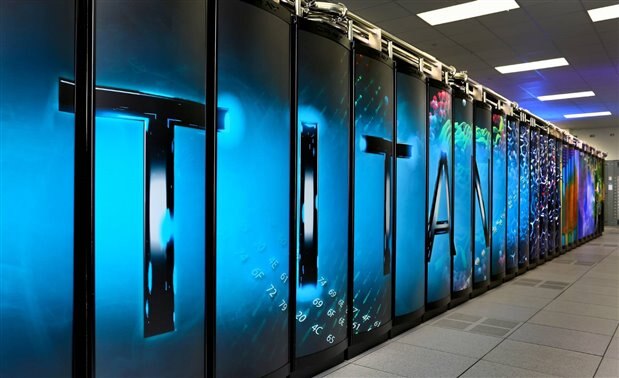
Oak Ridge National Laboratory’s TITAN is currently the world’s second fastest supercomputer.
To ensure that the United States maintains a leadership position in High-Performance Computing (HPC) President Obama has issued an Executive Order establishing the National Strategic Computing Initiative (NSCI), whose charter will be to advance core technologies to solve difficult computational problems and foster increased use of these capabilities in the public and private sectors.
Among the initial tasks assigned to NSCI will be to oversee development of the world's fastest computer by 2025. The proposed supercomputer would be capable of making one quintillion (a billion billion) calculations per second (known as one exaflop, or 1018 operations per second), as well as manage and analyze data sets of up to one exabyte (1018 bytes). This supercomputer would be 20 times faster than the current leading machine, which is in China.
The supercomputer being planned could give clinicians tools to better understand the complex biological mechanisms underlying a patient’s disease, and to better predict the most effective treatments via the ability to process large volumes of health and genomic data. As DNA sequencing technology improves, the volume of data will continue to increase and so, too, will the computational requirements. NSCI’s efforts could shorten the time it takes to sequence samples and improve accuracy.
The twin goals of exaflop computing ability and exabyte storage capacity should also enable more precise simulation of weather patterns that can be coupled with actual observations from weather satellites. A recent study commissioned by NASA determined that machines able to sustain exaflop-level performance also could incorporate full modeling of turbulence, as well as more dynamic flight conditions, in their aviation simulations.