


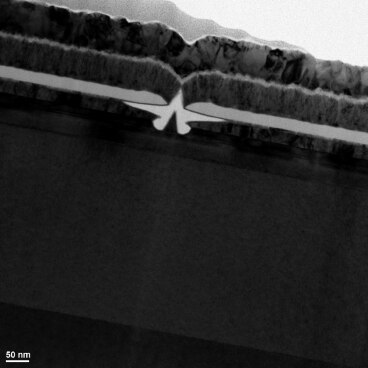
A cross-section transmission electron micrograph of the fabricated transistor. The central inverted V is the gate. The two molybdenum contacts on either side are the source and drain of the transistor. The channel is the indium gallium arsenide light color layer under the source, drain and gate.
Image courtesy of the researchers (via MIT)
Transistors are one of the most significant components that sparked the beginning of the computing revolution, this month it is celebrating its 65 year. December 16, 1947 saw Bell Labs researchers created a germanium crystal amplifier that had a 100x effect on the input signal. The transistor’s inner workings rely on its use of a semiconductor material – a material with specific electronic properties allowing it to act as a conductor or an insulator depending on its application. A transistor is an electronic device that can be used both as a switch to signal other devices on or off, and as an amplifier which increases the incoming electric current. It comprises of three electrodes: a gate, source, and drain. Texas Instruments produced the first silicon transistor back in 1954; Silicon has since been the primary material used in microchips.
Shortly after, in 1965, the Intel co-founder Garry E. Moore published an observation he made on the study of transistors in integrated circuits. The observation, which later became known as Moore’s Law, stated that the number of these devices used in electronic components would double every year for at least ten years. Well, it turns out that this trend has continued since, and has been strongly linked to the capability and performance of many electronic devices. This exponential growth in technology is the reason most of the electronic devices we use on a daily basis appear to get better and better every year.
So, if you’re reading this article on just about anything that isn’t paper, you are bound to be using an electronic device loaded with transistors. For that matter, there is significant importance placed on the size of transistors as the number of them used continues to grow year by year.
Until recently, no one had successfully produced transistors out of any other material while keeping their size small enough to pack more of them on a computer chip. Silicon has also begun to reach its peak in terms of size and performance, which prompted many to think Moore’s Law would not hold for much longer.
MIT researchers have now successfully developed a MOSFET (Metal-Oxide-Semiconductor Field-Effect Transistor), which comprises of indium gallium arsenide as its semi conductor material rather than the ever-popular silicon. Its advantage over silicon emerges from its superior electron velocity, allowing it to maintain a high output current as the size of the transistor shrinks.
Most of the techniques used in manufacturing the indium gallium MOSFET are already in-use for silicon chip production. However, this is the first time these techniques have been used to create a compound semiconductor transistor. The process involved first using molecular beam epitaxy to grow a thin layer of the indium gallium arsenide compound through evaporation inside of a vacuum. Next, a layer of molybdenum is applied as the source and drain electrodes. Electron beam lithography is then used to carve away-unwanted material where the gate oxide is placed. Finally, evaporated molybdenum is aimed at the surface of the compound where the gate is formed between the source and drain contacts.
The application of this material in transistors breathes new life into Moore’s vision of an accelerating technological growth. The compound transistor was developed at an already impressive length of 22 nm, but the research team hopes to bring its size down to below 10 nm in gate length! The next step also involves improving the material’s electrical properties to further increase its performance. Clearly, there is much to look forward to once this new technology begins to make its way into our everyday electronic devices. How much thinner, lighter, smaller, and faster can we go? We’ll have to wait to find out – but not too long, as Moore has shown us.
Cabe

