


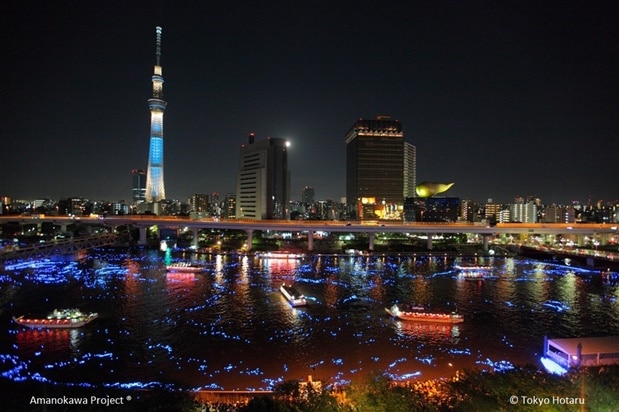
LED Wishing Star art show (via Tokyo Hotaru)
LEDs have been used to create some of the world’s most interesting art. One of the more impressive pieces was showcased at the Licht Festival in Belgium last year, showcasing the cathedral of light. This year brought another large display of LEDs from Panasonic for Tokyo’s Hotaru Festival (Firefly Festival) which celebrates an age old tradition of…well…watching fireflies along river-banks. Panasonic took part in the ‘Symphony of Light’ celebration by releasing 100,000 ‘wishing star’ LED free-floating balls into Tokyo’s Sumida river which was complemented by the illuminated Tokyo Sky Tree. Each ball contains an individual LED which is powered by a tiny solar-cell and rechargeable battery making them fully self-sustainable and reusable. The piece is strikingly similar to what Mother Nature does naturally with bioluminescence.
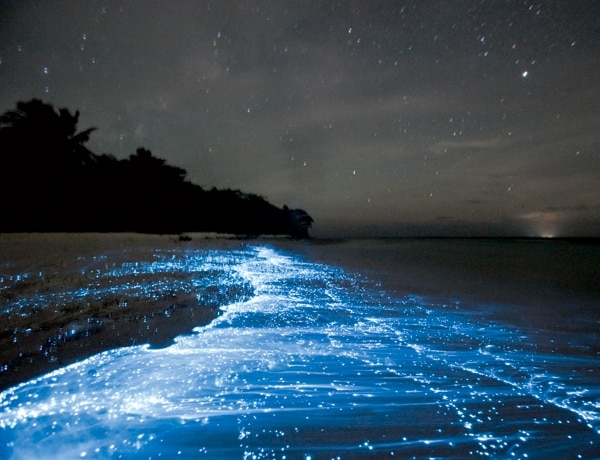
Bioluminescent bloom of plankton, Maldives (via Doug Perrine)
Illuminating art can be found in nature and also uses self-sustainable energy like Panasonic’s ‘wishing star’ LED balls. These however rely on a chemical reactions (chemiluminescence) rather than solar to emit light. Plankton (much like the firefly) use a group of chemicals, known as luciferins, that oxidize and set off a catalyst called luciferase which produces ‘cold light’. Many of this plankton wash up on various shores where lucky on-lookers can appreciate a fantastic light-show like that recently found on Vaadhoo Island in the Maldives. Both of the displays were impressive in their own right, but only one of them was edible which edges Mother Nature as the winner of the illuminated art shows!
Cabe
More of the Panasonic Tokyo art show:
-

DAB
-
Cancel
-
Vote Up
0
Vote Down
-
-
Sign in to reply
-
More
-
Cancel
Comment-

DAB
-
Cancel
-
Vote Up
0
Vote Down
-
-
Sign in to reply
-
More
-
Cancel
Children