element14 Community
element14 Community
    Register Log In
  • Site
  • Search
  • Log In Register
  • Community Hub
    Community Hub
    • What's New on element14
    • Feedback and Support
    • Benefits of Membership
    • Personal Blogs
    • Members Area
    • Achievement Levels
  • Learn
    Learn
    • Ask an Expert
    • eBooks
    • element14 presents
    • Learning Center
    • Tech Spotlight
    • STEM Academy
    • Webinars, Training and Events
    • Learning Groups
  • Technologies
    Technologies
    • 3D Printing
    • FPGA
    • Industrial Automation
    • Internet of Things
    • Power & Energy
    • Sensors
    • Technology Groups
  • Challenges & Projects
    Challenges & Projects
    • Design Challenges
    • element14 presents Projects
    • Project14
    • Arduino Projects
    • Raspberry Pi Projects
    • Project Groups
  • Products
    Products
    • Arduino
    • Avnet & Tria Boards Community
    • Dev Tools
    • Manufacturers
    • Multicomp Pro
    • Product Groups
    • Raspberry Pi
    • RoadTests & Reviews
  • About Us
  • Store
    Store
    • Visit Your Store
    • Choose another store...
      • Europe
      •  Austria (German)
      •  Belgium (Dutch, French)
      •  Bulgaria (Bulgarian)
      •  Czech Republic (Czech)
      •  Denmark (Danish)
      •  Estonia (Estonian)
      •  Finland (Finnish)
      •  France (French)
      •  Germany (German)
      •  Hungary (Hungarian)
      •  Ireland
      •  Israel
      •  Italy (Italian)
      •  Latvia (Latvian)
      •  
      •  Lithuania (Lithuanian)
      •  Netherlands (Dutch)
      •  Norway (Norwegian)
      •  Poland (Polish)
      •  Portugal (Portuguese)
      •  Romania (Romanian)
      •  Russia (Russian)
      •  Slovakia (Slovak)
      •  Slovenia (Slovenian)
      •  Spain (Spanish)
      •  Sweden (Swedish)
      •  Switzerland(German, French)
      •  Turkey (Turkish)
      •  United Kingdom
      • Asia Pacific
      •  Australia
      •  China
      •  Hong Kong
      •  India
      •  Korea (Korean)
      •  Malaysia
      •  New Zealand
      •  Philippines
      •  Singapore
      •  Taiwan
      •  Thailand (Thai)
      • Americas
      •  Brazil (Portuguese)
      •  Canada
      •  Mexico (Spanish)
      •  United States
      Can't find the country/region you're looking for? Visit our export site or find a local distributor.
  • Translate
  • Profile
  • Settings
Publications
  • Learn
  • More
Publications
Blog Pen & ink for drawing conductive circuits
  • Blog
  • Documents
  • Events
  • Files
  • Members
  • Mentions
  • Sub-Groups
  • Tags
  • More
  • Cancel
  • New
Join Publications to participate - click to join for free!
  • Share
  • More
  • Cancel
Group Actions
  • Group RSS
  • More
  • Cancel
Engagement
  • Author Author: Eavesdropper
  • Date Created: 29 Jun 2011 7:56 PM Date Created
  • Views 721 views
  • Likes 1 like
  • Comments 4 comments
  • research
  • dit
  • trace
  • eavesdropper:dit
  • on_campus
  • circuit_printing
  • wire
  • university
  • pen
  • innovation
  • ink
Related
Recommended

Pen & ink for drawing conductive circuits

Eavesdropper
Eavesdropper
29 Jun 2011
image
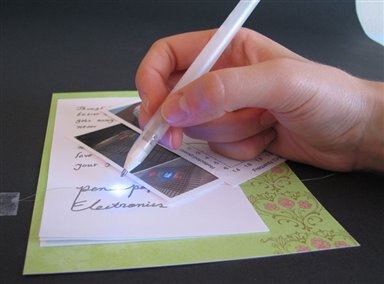
An LED mounted in a hand written trace of words
 
Materials Engineering meets Electrical Engineering, a new way of laying circuit traces is born.
 
University of Illinois professors Jennifer Lewis (materials) and Jennifer Bernhard (electrical) developed a pen that holds "metallic ink" that can be used to draw a circuit trace on paper. "This is an important step toward enabling desktop manufacturing (or personal fabrication) using very low cost, ubiquitous printing tools," said Lewis. (See the paper here)
 
image
LED matrix array on drawn traces, paper flexed
 
Nanoparticles of element Ag are reduced in a Ag-nitrate solution, with an acid to prevent the particles from growing. The acid is removed, and the "ink" is mixed with hydroxyethyl cellulose to create a proper consistency. The liquid metal ink stays a liquid in the pen, but once applied to a surface dries quickly. The ink paths are conductive, and can maintain its conductivity on folded paper. “The key advantage of the pen is that the costly printers and printheads typically required for inkjet or other printing approaches are replaced with an inexpensive, hand-held writing tool,” says Lewis.
 
An artistic explosion of drawn circuits will follow the immediate release of the ink to consumers. In fact, the research team let artist Jung Hee Kim use the ink in the painting below, titled "Sae-Han-Do."
 
image
Sae-Han-Do by Jung Hee Kim with one LED mounted in the house roof
 
The team plans to make other inks that will allow for drawing/writing on other surfaces including other conductive metals. Multilayer circuits in a whole new way.
 
I have wanted this for years. Collaboration between practices shows its potential, more of us should work together.
 
Eavesdropper
 
  • Sign in to reply
  • Eavesdropper
    Eavesdropper over 14 years ago in reply to Former Member
    Inkjet type printed circuit boards are old news. In 2004 Epson printed a 20 layer circuit board with an inkjet. It contained insulating layers as well. In 2007 another inkjet printer was capable of printing circuits using a similar solution like in the pen above. The printer produced circuits with high resistance, since all the metallic elements were in poorly connected dots. Though this doesn't sound like a huge hurdle to me, it stopped many people from pushing the idea further.
     
    Now we just have to find out, does the conductive ink peal? What is the ampacity per mm?
     
    E
    • Cancel
    • Vote Up 0 Vote Down
    • Sign in to reply
    • More
    • Cancel
  • Former Member
    Former Member over 14 years ago

    graphite pencil leads also conduct electricity, but ink in the form of a printer cartridge refill, and we've got quick and easy hi-res precision.

    • Cancel
    • Vote Up 0 Vote Down
    • Sign in to reply
    • More
    • Cancel
  • Former Member
    Former Member over 14 years ago in reply to DAB

    i need some! think of the logistics of the saved fabrication expenses.

    • Cancel
    • Vote Up 0 Vote Down
    • Sign in to reply
    • More
    • Cancel
  • DAB
    DAB over 14 years ago

    It was only a matter of time before researchers implemented the 3D printing technique for these types of applications.  We should be seeing a lot of interesting and flexible circuits built into just about everything.


    The future is going to be a very interesting place.  Think of all the solar cells you could weave into clothing, put on vehicles, buildings, sidewalks, etc.  We can only be stopped by our lack of ambition.


    DAB

    • Cancel
    • Vote Up 0 Vote Down
    • Sign in to reply
    • More
    • Cancel
element14 Community

element14 is the first online community specifically for engineers. Connect with your peers and get expert answers to your questions.

  • Members
  • Learn
  • Technologies
  • Challenges & Projects
  • Products
  • Store
  • About Us
  • Feedback & Support
  • FAQs
  • Terms of Use
  • Privacy Policy
  • Legal and Copyright Notices
  • Sitemap
  • Cookies

An Avnet Company © 2025 Premier Farnell Limited. All Rights Reserved.

Premier Farnell Ltd, registered in England and Wales (no 00876412), registered office: Farnell House, Forge Lane, Leeds LS12 2NE.

ICP 备案号 10220084.

Follow element14

  • X
  • Facebook
  • linkedin
  • YouTube