


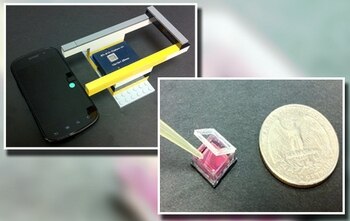
ePetri patform of cell phone and LEGOs (left), imaging sensor (right)
The California Institute of Technology, CalTech, has built a new way to culture cells using LEGOs, a smartphone, and some high tech imaging devices that will change petri dish usage forever. Guoan Zheng, grad student and author of the study, explained, "Our ePetri dish is a compact, small, lens-free microscopy imaging platform. We can directly track the cell culture or bacteria culture within the incubator. The data from the ePetri dish automatically transfers to a computer outside the incubator by a cable connection. Therefore, this technology can significantly streamline and improve cell culture experiments by cutting down on human labor and contamination risks."
A few of the features will help it take dominance in the medical field. The complete system, built around legos, is sealed in an incubator, which keeps contamination due to handling to an absolute minimum. The imaging sensor can take rapid wide-angle pictures of the Petri dish, which are immediately transferred to a computer and pieced together into a larger high-resolution image. The on-chip imaging is based on subpixel perspective sweeping microscopy (SPSM).
Senior author of the study, Professor Changhuei Yang, said, "Until now, imaging of confluent cell cultures has been a highly labor-intensive process in which the traditional microscope has to serve as an expensive and suboptimal workhorse. What this technology allows us to do is create a system in which you can do wide field-of-view microscopy imaging of confluent cell samples. It capitalizes on the use of readily available image-sensor technology, which is found in all cell-phone cameras."
According to the study, the cell phone is only used for its LED screen as a scanning light source. Although some phones, in this case an Android phone, can be inexpensive, it seems like a waste to use the whole phone for just back lighting. I am sure there are cheaper alternatives.
The team believes that their scanner will open up new possibilities for portable diagnostic lab-on-a-chip tools. Other areas they will be pushing the tech are in drug screening, detection of toxic compounds, and stem cell research.
Let's hope the final design is not laying on LEGOs. I would not assume there is high precision between blocks.
Eavesdropper
