


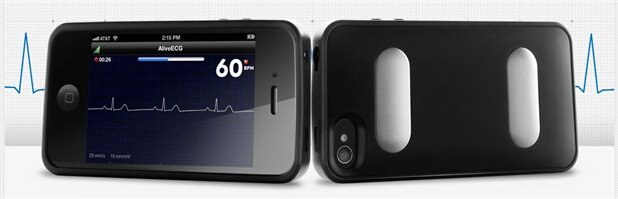
AliveCor concept (via alivecor.com)
Innovation and development with smartphones continues to amaze, there are many people out there with ambitious ideas as to how our portable devices could help us in unimaginable ways. From touch screens that detect bacteria and viruses, apps that tell us when we are stressed, even spectrometry, our little portables are doing more and more every year. Now, the company AliveCor is equipping your phone with a rudimentary ECG monitor, giving users the capability of seeing, in real-time, the beating of a living heart.
The AliveCor low-cost, mobile ECG monitor is a device that snaps onto an iPhone 4/4S like a case. This case has two sensors that, when placed up to the heart for 30 seconds or more, can detect its electrical activity. The device communicates wirelessly with a free downloadable AliveCor App automatically (no additional paring is required). On the app, one can monitor heart function by seeing the hearts actual electrical signal. This can be used to update doctors of patients conditions form their homes.
So far, the company is only selling heart monitors designed for veterinarians, for $199, but these work the same way as described above. The AliveCor monitor doesn’t require shaving just cleaning of the area to be tested with alcohol. The company made a website (AliveCorVet.com), called the AliveCor ECG Hub, where the user can upload ECGs and these can be accessed by anyone, anywhere like caretakers and vets.
Eventually the same services will be available for humans and will give patients, caretakers and physicians the same convenient tools. It is doubtful that this device will completely replace going to the doctor for an ECG because cardiologists use up to 10 electrodes, placed at different parts of the body, to look at the heart from 12 different “angles." Still, this heart monitor has one lead (two sensors) that can give readings from 7 locations and allows for results to accessed via the cloud, emailed, annotated and printed to be analyzed by a doctor. This could show signs of heart disease and many other abnormalities crucial for high-risk patients.
The AliveCor heart monitor has not received approval from the FDA, but it has received an unofficial endorsement by Scripps cardiologist Dr. Eric Topol, who has used it on humans and has seen its accuracy compared to conventional ECGs. Dr. Topol used it to diagnose a heart attack on a passenger complaining of chest pains on a flight. An emergency landing was made, and the passenger got adequate treatment. Dr. Rajesh Dash from the Stanford School of Medicine also agrees that portable ECGs are a great idea, patients are much more likely to carry them and comply with doctors orders to perform monitoring.
Like their mission? AliveCor is hiring engineers in the San Francisco area.
Cabe

