


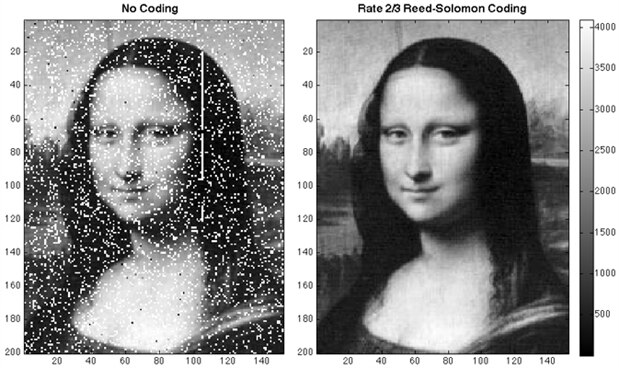
(Left) Transmitted Mona Lisa image missing parts due to noise and interference. (Right) Cleaned up image using the "Reed-Solomon" error correction sheme from CDs and DVDs. White stripe was a brief persiod in which the signal was paused. (via NASA Goddard & Xiaoli Sun)
Associating Davinci’s Mona Lisa with communications technology seems a little ‘out there’ but that’s exactly what NASA was thinking when they recently sent the iconic image to their Lunar Reconnaissance Orbiter (LRO) using a laser communication system. NASA sent the image at close to 240,000 miles to the LRO, piggybacked on a pulsed laser stationed at the NGSLR (Next Generation Satellite Laser Ranging) facility located at NASA’s Goddard Space Flight Center in Maryland. NASA typically uses the laser to track the satellites position by aiming the beam at the LRO’s Lunar Orbiter Laser Altimeter, which provides scientists with a topographical model and geodetic grid of the moon’s surface. According to NASA, this was the first successful test of two-way laser communication at a ‘planetary distance’. In order to send the digital image to the satellite, the scientists separated the Mona Lisa into an array of 152 X 200 pixels, which were then changed from different colors to varying degrees (4,095 in all) of grey for each individual pixel. They then sent each individual pixel (separately) on a laser pulse to the LRO at a precise time slot that allowed for 4,096 individual transmissions (or roughly 300 bits per second) to complete the image. The team verified that the transmission was successful when the satellite returned the image back to Earth over conventional radio signals sent from the moon-based bird. One of the major obstacles that needed to be overcome to effectively send the image was the Earth’s own atmospheric turbulence (which is present even on clear nights) which was found to cause numerous transmission errors. In order to combat the problem, the team used what’s known as ‘Reed-Solomon error correction coding’, which is found on CDs and DVDs to provide near-flawless playback of media. NASA hopes to refine the laser communication system for future moon missions as well as low-orbit and deep space communication.
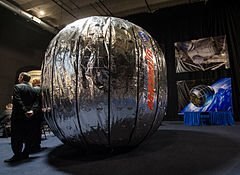
Bigelow Expandable Activity Module. A temporary inflatable section of the International Space Station. (via Bigelow & wiki)
NASA’s laser communication system may even be used to communicate with astronauts stationed in new inflatable habitats that are set to be tested on the ISS (International Space Station) in the near future. In a recent publicized press conference, NASA announced their new partnership with Bigelow Aerospace to test the companies new BEAM (Bigelow Expandable Activity Module) inflatable habitat. The module is similar to the company’s BA-330 habitat (only smaller) which has 12,000 sf (330 cubic meters) of internal space and features an outer ‘skin’ made of around 2-dozen layers consisting of Nextel (3M’s ceramic fabric) with open celled foam sandwiched between them. These layers are reported to be strong enough to defend against space debris including tiny meteorites. Just in case they’re not, the habitat has redundant layers of Kevlar and Vectran (fabric made from liquid crystal polymer), which provides a certain amount of rigidity to the module as well as another degree of protection. Situated between the bulletproof layers are inflatable bladders (made of Combitherm material commonly found in the food packing industry) that not only expands (using included O2 tanks) the habitat into its full-sized module but also acts as an insulator from the harsh extremes of temperatures in space. Lastly, the inner wall of the module is lined in Nomex fabric that provides fire protection as well as a level of resistance against scrapes and scratches that could otherwise damage the balloon-like habitat. Bigelow was awarded a $17.8 million US contract from NASA to ready the BEAM module (which will be transported on the SpaceX Dragon space craft) for testing on the ISS by 2015 where it will undergo 2 years of feasibility testing and then be jettisoned into the Earth’s atmosphere where it will burn up on re-entry. According to NASA, the test results will provide valuable information on the continued effects space has on the human body over prolonged periods of time, which is critical information, needed if we’re ever to go to Mars.
Cabe