


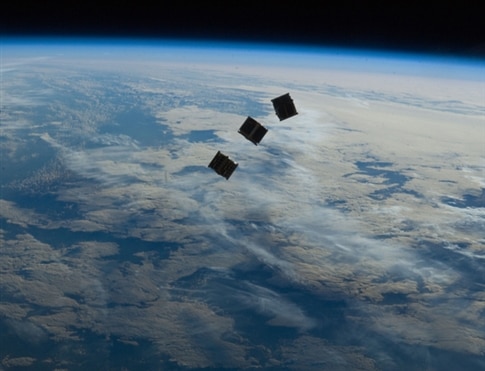
San Jose State University, California student satellites (via NASA)
Some 50 plus years into our space exploration we continue to push the limits of devices, objectives, and human beings. We continue to analyze the past and lay groundwork for the future of humankind. Collaborations between mega-businesses and the federal government are leading to new ways to travel into space. At the same time, collaborations between Russian and the US and Germany and Japan are also making great stride to further our current knowledge of space and how humans could use its resources during long term deep space missions to asteroids and Mars.
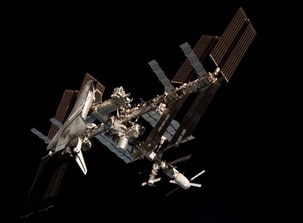
International Space Station (via NASA)
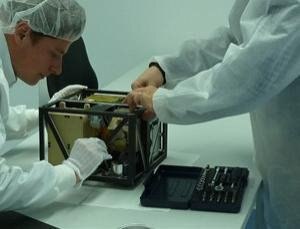
Electrical devices are getting smaller and smaller. This applies even to satellites placed in orbit. A project by the San Jose State University, in California gave aerospace engineering student interns $30,000 to build tiny satellites that carry ordinary ham radios and avionics equipment in to orbit. The TechEdSats are a mere 10 cm across and where launched from the Kibo Laboratory on the ISS this month and will stay in orbit for about two weeks. The aim of the project was not so much experimental as it was experiential; to familiarize students with the entire life of a space mission.
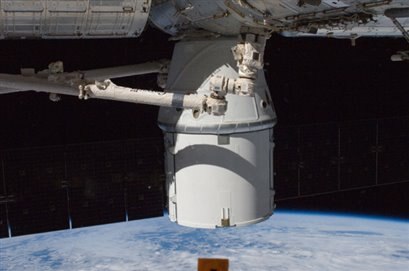
Dragon on the ISS as of October 10th, 2012 (via SpaceX & NASA)
The folks over at SpaceX have already accumulated a bit more experience then the San Jose State team. Docking of the private company’s spacecraft on the ISS is becoming routine. Earlier this month, the SpaceX’s Dragon successfully coupled with the space station bringing a cargo full of vehicle hardware, supplies for experiments, an ultra-cold freezer for storing scientific samples and general supplies for the crew which included real soft ice-cream, not that dehydrated variety. The Dragon will make a splash return in the Pacific Ocean on October 28th.
The kinks of this type of commercialized space travel is still being worked out. Trying to take advantage of all business opportunities, the Dragon was supposed to release an Orbcomm communications satellite intended for Orbcomm’s own research. The Dragon craft was propelled by the Falcon, a nine-engine rocket. Unfortunately, one of these engines shut down due to a sudden drop of pressure, which caused them to burn the remaining 8 engines for longer than expected. Though redundancy is a vital safety feature of these rockets, a second burn, that was originally supposed to drop off the Orbcomm satellite at around 700 km, was scrubbed in order to avoid jeopardizing the ISS. So, the Dragon was forced to dump the satellite at only 410 km, which doomed it to fall back and burn up in the atmosphere, though Orbcomm said they managed to gather some data. The company is now filing a $10 million insurance claim. The perils of the modern space race.
Hiccups like these are likely to be experienced again in the future. NASA and other space agencies are not a fan of such errors as they could be potentially deadly. To fulfill with their agendas for the coming decades, they plan to begin studying what it will take to launch manned missions into deep space well before they launch (near earth asteroids by 2025 and Mars in the 2030’s). The US and Russia jointly announced that they will launch a mission in 2015 that will put humans in the ISS for a full year (the current maximum time allowed on the ISS is 6 months, although cosmonaut Valery Polyakov lived on the Russia’s Mir space station from January 1994 to March 1995). This mission will explore long term effects of microgravity on bone density, muscle mass, strength and vision among other pertinent factors. NASA has plenty of research on short exposures to microgravity and isolation but little on long-term exposure. The mission will embark using the 3-seat Soyuz capsule shuttling an American and a Russian astronaut and maybe a space tourist to fill the third seat. Sarah Brightman British Opera singer has thrown her hat in the mix.
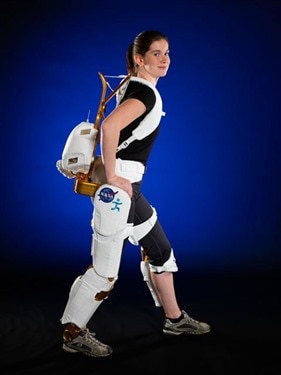
X1 exoskeleton PR image (via NASA)
When the time comes to embark on those long missions to space, it is likely that NASA will supply them with a version of the X1. This machine is an exoskeleton suit that can be used for many purposes. Its two main modes are to aid or inhibit leg joints. The 57 lb suit straps around the legs and over the back. In inhibit mode, it offers resistance to be used as an exercise machine. Motorized hips and knee joints can provide resistance or also assistance and 10 degrees of freedom allow for sidestepping, turning, pointing and flexing the foot. X1 also records exercise data that can be sent to physicians on Earth to monitor the health and exercise routines of the astronauts through long trips in space.
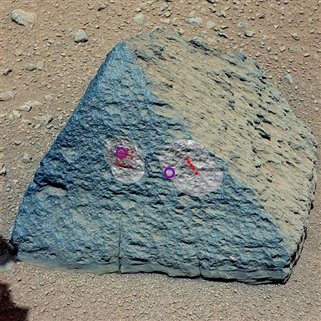
"Jake Matijevic rock." The red dots and purple areas are where the APSX and ChemCam instruments targeted the rock. (via NASA & Wiki)
Before you dismiss all of these costly efforts as potentially meaningless or fruitless, missions are already being conducted to find out what we may find when we travel to these distant rocks. The Mars explorer ‘Curiosity’ has already spent months on the red planet and has made some intriguing findings with its x-ray spectrometer as to the mineral composition of some rocks. In particular the “Jake Matijevic rock” a named after a NASA engineer that died a few days after the Curiosity landed, has puzzled NASA because of its varied and somewhat Earth-like composition. Similar to Feldspar, the rock contains sodium, aluminum, potassium, and traces of magnesium, iron and nickel. If the right materials can be found on Mars, generating fuel on the planet will be possible. Jacob Matijevic was a mathematician-turned-rover-engineer, critical to the Curiosity rover development. Matijevic died just a few days after the rover landed in August.
Hayabusa 2 (via JAXA)
Another collaboration between the German Aerospace Center (DLR) and the Japan Aerospace Exploration Agency (JAXA) is exploring the asteroid 1999 JU3 before this decade is through. The Hayabusa 2 spacecraft will be shuttling the first ever mobile asteroid explorer called the MASCOT (mobile asteroid surface scout). Once there, the MASCOT will use revolving weights to fling itself across the asteroids unknown terrain and microgravity environment. It will collect information about the surface of the rock including mineral properties and mappings with some samples that Hayabusa 2 collects and returns to Earth. 1999 JU3 is a carbonic asteroid of the type most common near Earth. Knowledge of its composition could help us determine the root for life on our planet, and whether these asteroids could be used for mining resources in the future. It might also bring insight into how we would deflect one of these rocks if one were ever Earth bound.
There is much still happening in space exploration, though it may not get the buzz the industry once enjoyed in the 60s. Make sure to keep track of these up and coming projects that will have direct implication to where we will be exploring in the next 2 decades.
Cabe
See more here:
Privatized Space Race: Part One - ATK, SpaceX, and a real Star Trek Enterprise
Privatized Space Race: 2 - SpaceX freight and reusable rocket
Who will be better for the Engineering Industry — Romney or Obama?