


While the new space race is not getting the hype that the mid 1900's enjoyed, it is in full swing and there are many more contenders and pioneering projects than ever before. The multibillion-dollar era has fertilized the ground for what seems like a new age where the federal governments and private companies, join authorities to launch federal and private missions to space.
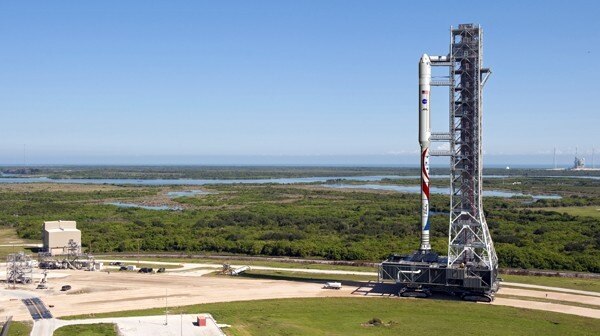
ATK freighter (via ATK)
From May 21st to the 23rd, government leaders and industry officials gathered at the 'Spacecraft Technology Expo' to discuss new technologies and how private contractors could be part of the future of human space flight. They plan to gathe again in 2013.
Utah based company Alliant Techsystems (ATK) has an existing relationship with NASA, building rocket boosters. Kent Rominger, ATK Vice President and Program Manager for the Liberty project hopes that NASA could rent their new “very, very simple and inherently safe and reliable” launch system that will have the Liberty rocket system at its core. Their space vehicle will be capable of carrying a max of seven passengers as well as cargo could deliver satellites to orbit. For years, research on materials for building a composite crew module that would launch using ATK’s solid rocket motor and EAD’s Ariane 5 engine, which would make Liberty’s carrying capacity the greatest out of all of NASA’s ships. By 2015, the Utah based company ATK would like to provide an American alternative for NASA manned missions, which currently collaborate with the Russian ISS.
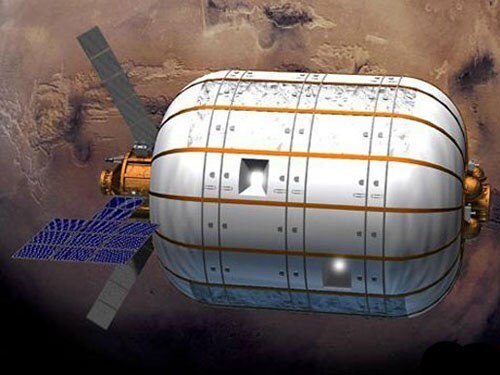
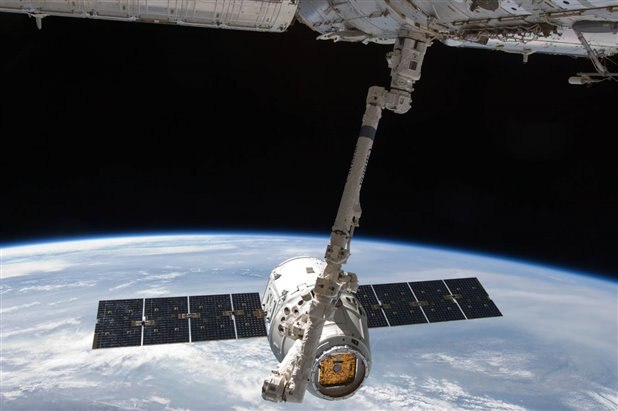
(Left) Habitat concept (via SpaceX & Bigelow) (Right) Dragon capsule docking with the International Space Station (via NASA)
But, the space race is providing more than technological advances and new opportunities for the federal government to continue its privatization.
New projects like the launch of the Dragon spacecraft funded by their parent companies, SpaceX and Bigelow Aerospace (BA) bring to the present, the possibilities many of us only believed would happen in the far off future. These companies are teaming up in an effort to bring space to regular people, or rather to send them into near-earth orbiting habitats. The Dragon craft, powered by SpaceX’s Falcon 9 rocket, carried upon it the BA 330, a habitat providing 330 cubic meters of living space that can support a crew of six. SpaceX and BA will run programs with international private companies, space agencies and universities with low gravity environments.
After a scrubbed attempt at launch on May 19, the Dragon was successfully sent on the first leg of its voyage to dock with the ISS, which is by itself a 75-hour trip. This may seem like a long time, but it is the first of many successes, which must be launched before companies like SpaceX can sell trips to space. They are the first privatized space flight corporation to dock with the ISS.
The companies are trying to get support for their projects internationally. Both will be meeting with Japanese officials in their quest for government and private support. They have already received much praise from President Obama on behalf of NASA, a promising client for these types of short space visits.
Plans for the not so far off future stretch far beyond near earth orbits. According to some aerospace experts, a trip to Mars in 90 days could very possible with the right equipment. Perhaps something like the nuclear-electric powered megaship designed by an engineer by the alias "BTE-Dan." His concept; The Enterprise, a spacecraft with a nuclear reactor capable of 1.5GW of power all the way to the Red Planet (Not quite travelling through time but still pretty sweet). once It would generate its own 1g gravitational environment with a gigantic rotating magnetically suspended gravity wheel.
This Enterprise is a ship that will be built with 0.27% of the U.S. GDP and will take about 20 years for the first generation ship to be completed. With a 40 billion dollar per year budget, it dwarfs next to expenditures like social security or the military, but it is intended to be a project that happens only once per generation or every 33 years.
As is clear from the estimated length of all of these projects, we still have a lot of time to stop and smell the rocket fuel. The strong collaboration between the private sector and federal governments is surely to continue launching missions into space. Rather than dividing those who have and those who have not, one hopes at some point, the general public will also have access to these transcending technologies that will redefine the relationship between the public, the private, governments, the Little Blue Dot and space.
Cabe