


In 1960 DuPont's Walther Grot discovered the synthetic compound Nafion could efficiently conduct ions and water through a network of nano-scale channels throughout the solid. Through research, a prototype fuel cell has been constructed using Nafion along with other organic batteries and a reverse-osmosis water purification. Only speculation have lead to advancements with Nafion due to the uncertainty on how the molecules in Nafion, tetrafluoroethylene based fluoropolymer-copolymer, interact and its irregular patterns.
However, two Virginia Tech research teams, lead by professors B. Moore and Louis A. Madsen, along with graduate students Jing Li and Jong Keun Park, measured the internal structure of Nafion and now know how to alter the structure to improve its performance. Using nuclear magnetic resonance (NMR) to trace the molecular motion. NMR and X-ray scattering techniques measured the molecular alignment within the solid Nafion.
Madsen explains, "We were looking at water molecules inside Nafion as internal reporters of structure and efficiency of conduction. The new feature we discovered is the locally aligned aggregates of polymer molecules in the material. The molecules align like strands of dry spaghetti lined up in a box. We can measure the speed (diffusion) of the water molecules and the direction they travel within those structures, which relates strongly to the alignment of the polymer molecule strands."
What is the urgent purpose of all this research?
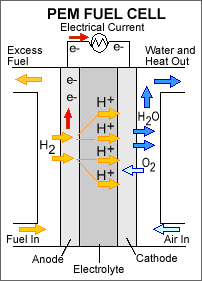
Nafion claim to fame comes with its excellent proton conduction in Proton Exchange Membrane Fuel Cells (PEMFC). The cell operate at ~80°C with a rapid startup time, up to 60% efficient, and can vary the output to match the demand. A favored replacement for combustion engines.
Anode Reactions: 2H2 => 4H+ + 4e-
Cathode Reactions: O2 + 4H+ + 4e- => 2 H2O
Overall Cell Reactions: 2H2 + O2 => 2 H2O
The 4H+ protons move through the electrolyte, while the 4e- conducts.
Eavesdropper

