


I recently selected a BJT for use in a power supply circuit. It was nothing complicated, so I used the venerable ‘3904. The transistor would have to handle 0.5A, so I needed to verify I wouldn’t need a high-power transistor.
I expected the collector-to-emitter voltage to be 0.5V, i.e. almost saturated. 0.5A through a 0.5V drop means 0.25W dissipated in the transistor (not counting power dissipated due to base current). The part in the SOT-223 package has a thermal resistance of 125C/W, junction-to-ambient. My board’s maximum ambient temperature will be 50C. The transistor’s maximum operating junction temperature is 150C, but I want to keep it under 125C to have a little headroom. So I can tolerate a 75C rise over ambient. Therefore the maximum heat I can dissipate is 75C / 125C/W = 0.6W If beta is 50, my base current will be 0.5A / 50 = 10mA, which means I need ad 70mW of dissipation due to base current. In any case, I had more than enough headroom on power dissipation.
After I released the board, however, I realized I had ignored the datasheet’s maximum collector current specification. Maximum collector current for normal operation is 100mA, and absolute maximum before risking damaging the device is 200mA. I had never used a BJT with more than a few mA, so I naively wondered if the datasheet was just assuming power dissipation associated with a higher V[CE]. Digging deeper, though, it’s clear that the problem is the beta drops as current rises.
I got out my Fundamentals of Solid-State Electronics book from undergrad, and sure enough there is an entire section on this effect. Several mechanisms are responsible. The main causes are a) electron concentration in the base (P) region exceeding the density of positive dopants and b) the voltage varying within the base region itself.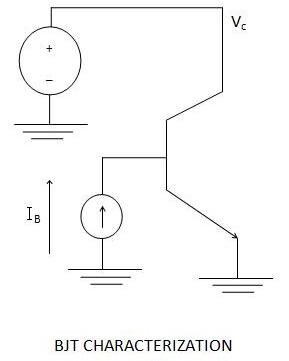
To test this I applied a V[CE] of a little over 1V to a TO-92 package 2N3904. I used another power supply in current limiting mode to inject base current. As expected, when moved the base current from 0 to 1mA, I observed the collector current jump from 0 to 70mA. As I increased the base current, however, the amount of collector current increase per increase in base current (i.e. beta) decreased. When base current was 100mA, collector current was 500mA, representing a beta of 5. Increasing base current further had little effect on collector current. I tried increasing the collector voltage to over 2V to see if some V[CE(sat)] effects were coming into play. The results were the same. The transistor got hot, of course, but exposing it to these currents briefly did not appear to damage it. Further experiments would use a function generator and a small resistor providing the base current.
I’ve seen enough to make me read the beta-vs.-current data any time I use a BJT at high current. The good news is there are a lot of BJTs with higher betas and a higher maximum current capabilities available in the same package and pinout as the ‘3904.