element14 Community
element14 Community
    Register Log In
  • Site
  • Search
  • Log In Register
  • Community Hub
    Community Hub
    • What's New on element14
    • Feedback and Support
    • Benefits of Membership
    • Personal Blogs
    • Members Area
    • Achievement Levels
  • Learn
    Learn
    • Ask an Expert
    • eBooks
    • element14 presents
    • Learning Center
    • Tech Spotlight
    • STEM Academy
    • Webinars, Training and Events
    • Learning Groups
  • Technologies
    Technologies
    • 3D Printing
    • FPGA
    • Industrial Automation
    • Internet of Things
    • Power & Energy
    • Sensors
    • Technology Groups
  • Challenges & Projects
    Challenges & Projects
    • Design Challenges
    • element14 presents Projects
    • Project14
    • Arduino Projects
    • Raspberry Pi Projects
    • Project Groups
  • Products
    Products
    • Arduino
    • Avnet & Tria Boards Community
    • Dev Tools
    • Manufacturers
    • Multicomp Pro
    • Product Groups
    • Raspberry Pi
    • RoadTests & Reviews
  • About Us
  • Store
    Store
    • Visit Your Store
    • Choose another store...
      • Europe
      •  Austria (German)
      •  Belgium (Dutch, French)
      •  Bulgaria (Bulgarian)
      •  Czech Republic (Czech)
      •  Denmark (Danish)
      •  Estonia (Estonian)
      •  Finland (Finnish)
      •  France (French)
      •  Germany (German)
      •  Hungary (Hungarian)
      •  Ireland
      •  Israel
      •  Italy (Italian)
      •  Latvia (Latvian)
      •  
      •  Lithuania (Lithuanian)
      •  Netherlands (Dutch)
      •  Norway (Norwegian)
      •  Poland (Polish)
      •  Portugal (Portuguese)
      •  Romania (Romanian)
      •  Russia (Russian)
      •  Slovakia (Slovak)
      •  Slovenia (Slovenian)
      •  Spain (Spanish)
      •  Sweden (Swedish)
      •  Switzerland(German, French)
      •  Turkey (Turkish)
      •  United Kingdom
      • Asia Pacific
      •  Australia
      •  China
      •  Hong Kong
      •  India
      • Japan
      •  Korea (Korean)
      •  Malaysia
      •  New Zealand
      •  Philippines
      •  Singapore
      •  Taiwan
      •  Thailand (Thai)
      • Vietnam
      • Americas
      •  Brazil (Portuguese)
      •  Canada
      •  Mexico (Spanish)
      •  United States
      Can't find the country/region you're looking for? Visit our export site or find a local distributor.
  • Translate
  • Profile
  • Settings
Publications
  • Learn
  • More
Publications
Blog RC Hissing Cockroaches, this year's must have holiday toy
  • Blog
  • Documents
  • Events
  • Files
  • Members
  • Mentions
  • Sub-Groups
  • Tags
  • More
  • Cancel
  • New
Join Publications to participate - click to join for free!
  • Share
  • More
  • Cancel
Group Actions
  • Group RSS
  • More
  • Cancel
Engagement
  • Author Author: Catwell
  • Date Created: 14 Sep 2012 5:26 AM Date Created
  • Views 489 views
  • Likes 0 likes
  • Comments 0 comments
  • research
  • test
  • transportation
  • industry
  • hmi
  • robotics
  • sbc
  • life
  • robot
  • on_campus
  • cabeatwell
  • prototyping
  • measurement
  • university
  • medical
  • animal_testing
  • sensor
  • innovation
  • communication
Related
Recommended

RC Hissing Cockroaches, this year's must have holiday toy

Catwell
Catwell
14 Sep 2012

image

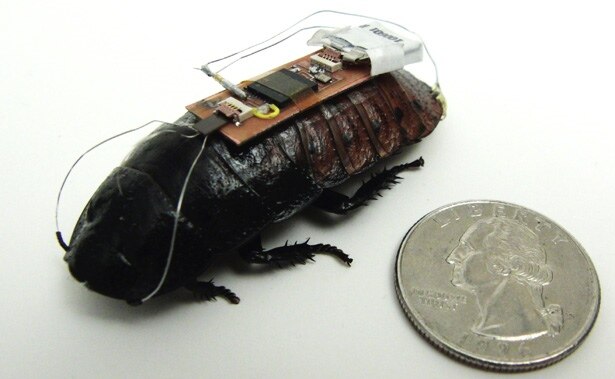
A roach under control (via Alper Bozkurt)


Whenever I see a cockroach scurrying through the house, I ask myself what could possibly be their purpose other than freaking me out. If there was just some way I could control them... Alper Bozkurt, assistant professor of Electrical Engineering at North Carolina State University, is part of a project that wants to make cockroaches an invaluable tool in any tight situation, literally.


Bozkurt and a team of researchers have proven that they can control a Madagascar Hissing cockroach, much like an RC car, by stimulating the roach’s antennae and cerci with electrodes.


The cerci organ, on the bug’s abdomen, detects small vibrations in the air that alert the roach when there is something behind it. To stimulate it, Bozkurt inserted an electrode through an incision hole in the thorax of an anesthetized cockroach. Sending an electrical signal to this area causes the bug to propel itself forward because it thinks something is chasing it.


The bug’s antennae were also "hacked" by surgically inserting Teflon coated 200-micrometer in diameter stainless steel electrodes into them. The antennae detect objects in front of the bug, and so stimulating the right antenna will make the roach move left and vice versa.


All of the surgical procedures were done after the insect had been anesthetized with a cold-treatment, and the cyborg roach was allowed to recover before experiments were conducted.


The team used a commercially available Texas Instrument CC2530 chip with an onboard microcontroller and wireless transceiver to make the backpack that sits on the roach’s back. This chip also serves to monitor the 3V electrical pulses to assure that the bug will not be harmed. The total weight of the system was only 0.7 grams.


Using this setup, the team was able to steer the roach along a curved path highly effectively. The team hopes that webs of coordinated roaches with smart sensors could be deployed in hostile environments to collect data about a given situation.


Bozkurt and his colleagues have done similar experiments on other bugs like moths. Their results were presented at this years IEEE Conference of the Engineering in Medicine & Biology Society in San Francisco. Alper Bozkurt stated, "Our aim was to determine whether we could create a wireless biological interface with cockroaches, which are robust and able to infiltrate small spaces. Ultimately, we think this will allow us to create a mobile web of smart sensors that uses cockroaches to collect and transmit information, such as finding survivors in a building that’s been destroyed by an earthquake... Building small-scale robots that can perform in such uncertain, dynamic conditions is enormously difficult. We decided to use biobotic cockroaches in place of robots, as designing robots at that scale is very challenging and cockroaches are experts at performing in such a hostile environment.” A pious goal, indeed.


You don't have permission to edit metadata of this video.
Edit media
x
image
Upload Preview
image


Cabe

http://twitter.com/Cabe_e14

  • Sign in to reply
element14 Community

element14 is the first online community specifically for engineers. Connect with your peers and get expert answers to your questions.

  • Members
  • Learn
  • Technologies
  • Challenges & Projects
  • Products
  • Store
  • About Us
  • Feedback & Support
  • FAQs
  • Terms of Use
  • Privacy Policy
  • Legal and Copyright Notices
  • Sitemap
  • Cookies

An Avnet Company © 2026 Premier Farnell Limited. All Rights Reserved.

Premier Farnell Ltd, registered in England and Wales (no 00876412), registered office: Farnell House, Forge Lane, Leeds LS12 2NE.

ICP 备案号 10220084.

Follow element14

  • X
  • Facebook
  • linkedin
  • YouTube