


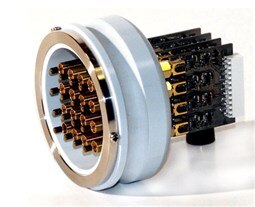
Inside the EPIC button sensor. Shows an array of 16 sensors. (Via Plessey Semiconductors)
On December 21, 2010 in Plymouth, England, Plessey Semiconductors signed a license agreement with the University of Sussex to develop EPIC, or Electric Potential Integrated Circuit Censors, a sensor capable of "reading a heart beat through a wall." The research team at University of Sussex is being lead by Professor of sensor technology Robert Prance, had been in development for the past 10 years. Targeted for use as electrocardiogram (ECG) sensors, they are now available and provide a resolution as good as or better than the conventional electrodes, without all the stickiness and hassle.
For example, the EPIC sensors are a dry contact so that no gels or other fluids are needed for attachment. The EPIC sensors can also be cleaned after each use, not like the ECG sensors that have to be thrown away after each use. With the EPIC, only a pair of sensors are required and held in each hand and can read heartbeats even through a sweater versus the most-recent approach that requires seven or more leads applied to specific locations of the body while the patient is laying down. All these examples help EPIC save time and money. According to Plessey, they are hoping to have future versions embedded in a hospital gurney for constant monitoring or where firefighters could possibly use it to find humans in a smoke filled room. This is simply amazing.
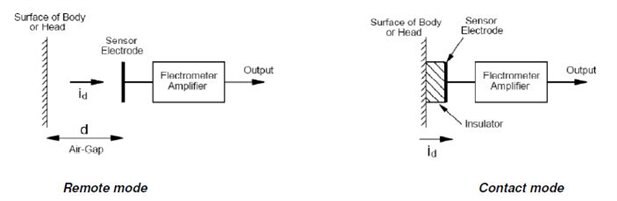
Sensor modes. Via Plessey Semiconductors
The tech behinds the scenes is simple. The device acts like a contactless digital voltmeter. The high-impedance sensor (10+ gigaohms) has the capability of detecting micro changes in electric fields that surround it. Since, the human body has a coupling capacitance near 250pF, the sensor can detect the ECG at the surface of the skin. The designers stated that the earth has a vertical electric field of 100V per meter and the human body, which is mostly water, interacts with the field. EPIC filters out all interferences (ie: earth's field) and gives the changes in the target body over various distances. The average size of the sensor is around 10mm square by 3mm thick. Plessey Semiconductors claims that they will build the device per the customer's specifications and financial situation. Remember, your company is poor and small when you order.
Eavesdropper