


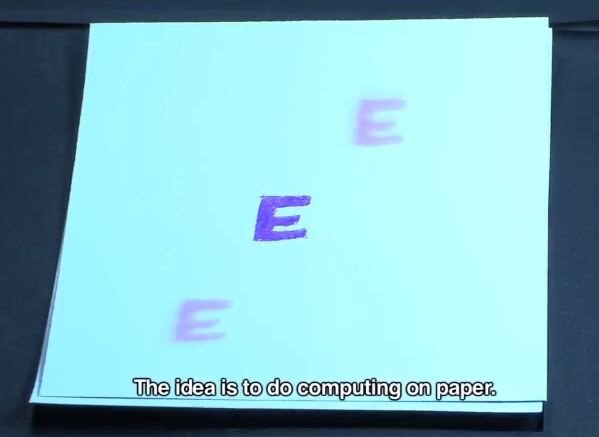
Center drawn "E" is replicated elsewhere on the photosensitive paper (via Diginfo)
Accessibility provided by the digital age is great. We can access digital files directly from the cloud from anywhere there is Internet. But, there is still something about holding a hard copy of a document that will likely never go out of style. Some will say that digitization is notable for saving trees and no one can deny that but soon, if the team from the Tokyo University spreads their idea successfully, we may have the best of both digital and tangible worlds while taking care of the natural world.
Researchers from the University of Tokyo’s Naemura Lab have developed a method that uses unique photochromic paper, which reacts to heat, high-resolution projectors, a camera and a laser to physically alter the appearance of a tangible document.
The photochromic paper can be altered by hand, by using PhotoScription or ThermoErasure. By the first method, the user can write using Frixion’s heat sensitive ink. Using PhotoScription the overhead DMD UV driven projector, with a 1024 x 768 pixel resolution, can edit images on the paper or draw directly onto it, in color, with the help of a computer. To erase, a heat-generating laser is used to erase the paper with the precision of 0.024mm.
The main goal is to bring tangible paper and computer together. With this type of setup, and perhaps clever automation, different copies of the same document could be edited far away from the original. The Naemura Lab team also wants to improve the rendering that is possible between hand drawn sketches and computers, giving more detail and enable drawing on a large surface area at once.
While the system may seem extraordinary, it is still a prototype and its results must be sped up if it will ever compare to services like Google Docs. Perhaps the Android app "QuantumDraw" is a better option, similar idea with less physical paper.
Cabe

