


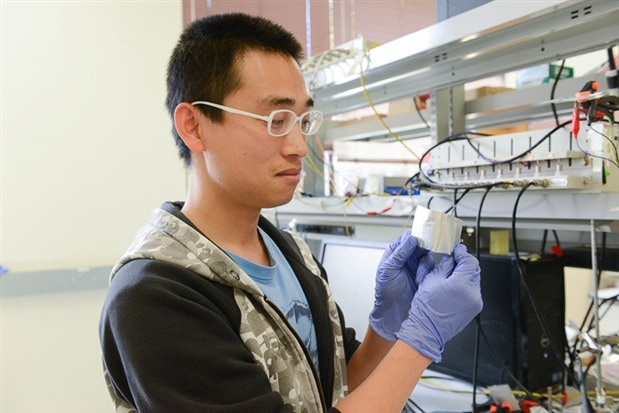
Stanford University Professor Hongjie Dai and colleagues have developed a high-performance aluminum battery.
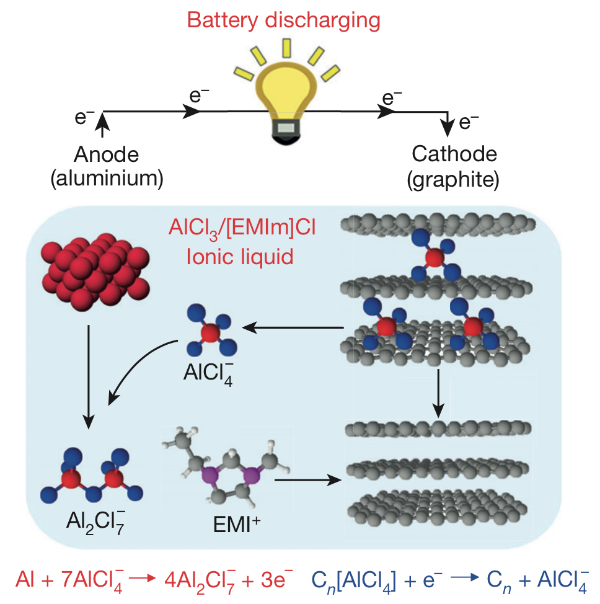
While it has been well known for some time now that rechargeable aluminum-based batteries could offer the possibility of low cost, low flammability and high capacity, research efforts have encountered numerous problems, such as cathode material disintegration, low cell discharge voltage and inadequate life cycles with rapid capacity decay. A key challenge has been in finding a cathode material that would result in the battery generating sufficient voltage after repeated cycles of charging and discharging.
Recently, Stanford University scientists have developed the first high-performance aluminum battery that's fast-charging, long-lasting and inexpensive.
"We have developed a rechargeable aluminum battery that may replace existing storage devices, such as alkaline batteries, which are bad for the environment, and lithium-ion batteries, which occasionally burst into flames," said Hongjie Dai, a professor of chemistry at Stanford. "Our new battery won't catch fire, even if you drill through it."
Dai and his colleagues described their novel aluminum-ion battery in a paper published in the online edition of the journal Nature.
An aluminum-ion battery consists of two electrodes: a negatively charged anode made of aluminum and a positively charged cathode. For the experimental battery the Stanford team placed the aluminum anode and graphite cathode, along with an ionic liquid electrolyte, inside a flexible polymer- coated pouch. "The electrolyte is basically a salt that's liquid at room temperature, so it's very safe," said Stanford graduate student Ming Gong, co-lead author of the Nature study.
Very fast charging is another benefit of the experimental battery. Smartphone owners know that it can take quite some time to charge a lithium-ion battery, but the Stanford team reported "unprecedented charging times" of down to one minute with the aluminum prototype.
Durability is important as well. Previous aluminum battery attempts usually died after just 100 charge-discharge cycles. But the Stanford battery is said to be able to withstand more than 7,500 cycles without any loss of capacity.
By comparison, a typical lithium-ion battery lasts about 1,000 cycles.
The aluminum battery is also flexible. It can be bent and folded so it has the potential for use in flexible electronic devices. Aluminum is also a cheaper metal than lithium so cost should not be a factor.
Further improvements will be needed, in particular in the area of matching the voltage of lithium-ion batteries. Dai noted "our battery produces about half the voltage of a typical lithium battery, but improving the cathode material could eventually increase the voltage and energy density.”