


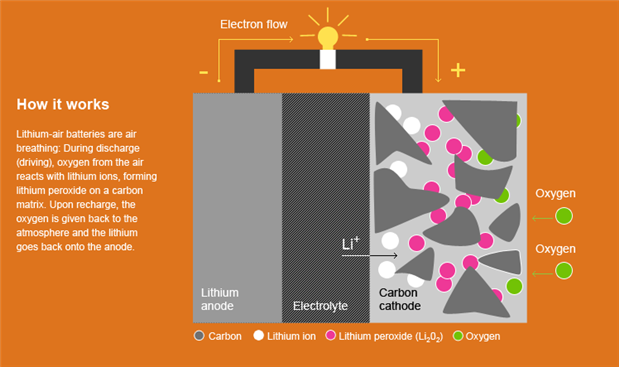
Concept diagram (via IBM)
We all know it is crucial to move from fossil fuel to electrically fueled transportation over the next decade. Unfortunately, a persistent problem with electrical vehicles is how their batteries can effectively and efficiently store electrical energy. IBM has found a solution to this problem by innovating on an existing type of battery with a twist; enter the Lithium-Air (Li-Air) battery.
Currently, electrical cars use rechargeable Lithium-ion batteries that can only supply cars with enough fuel for around 100 miles per charge. Li-Air batteries have been proposed since the 70’s because they boast of a theoretical energy density 1,000 times greater than Lithium-ion batteries which could translate to 500 miles/charge. This type of energy density is comparable to that of fossil fuels.
It is when Lithium-air batteries are recharged that they see a problem. IBM's Li-Air batteries use carbon as the positive electrode. They produce a current that travels through an electrolytic material between an oxidizing lithium anode and an oxygen reduction-oxidation (redox) carbon cathode.
Using a form of mass spectrometry to study the electrochemistry of the battery, IBM physicist Winfred Wilcke found that the oxygen, which conduct and reacts with the carbon anode, also chemically reacts with the batteries electrolytic solvent between the cathode and anode. This chemical reaction depletes the electrolyte material as well as the batteries capacity of producing electrical power after recharging. The challenge then was to find another electrolytic solvent that solved this recharging issue.
After using a Blue Gene supercomputer to run tests on extremely detailed models, they found an electrolyte material with the properties for the job. They are not revealing what the material is yet, but testing has show the material to be effective. A coalition of national laboratories along with IBM is working together and hope to have a full-scale working prototype working by 2013 and commercially available batteries by 2020.
In the name of profit, one can understand their secretiveness. It makes me wonder how fast we could achieve fully functioning Li-Air electrical cars if this project became open to the public or multiple organizations. How about a joint development between several corporations, and share in the profit? Li-Air batteries could be crucial to our 21st century energy development, if it could just get here faster.
Cabe