


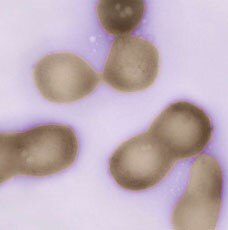
Image of the first M. mycoides JCVI-syn1.0 synthesized bacterium - J. Craig Venter Institute’s proof-of-concept for the promising future development of an entirely synthetic genome. (via J. Craig Venter Institute)
Genetic restructuring; building within nature is gaining momentum.
The topic of synthetic life creation, so- called “playing god,” is one of those grand topics that seems to get mass media coverage from all different angles - even those not normally focused on biological science advancements. And rightfully so. It is one of those pinnacle scientific achievements that can have wavering implications on the future of the planet, depending on how it is applied out in the world. Craig Venter, founder of the J. Craig Venter Institute has announced that he and his colleagues Clyde Hutchison and Hamilton Smith are not too far off from the creation of a completely synthetic bacterium.
The J. Craig Venter Institute located in Rockville, Maryland has dedicated itself to enhancing biological understanding of the world around us. Genomic science has much to do with recent advancements in their biological work, presenting new ways for scientists to begin communicating through DNA sequences much like a computer communicates through a series of 1s and 0s. Researchers are effectively taking the known DNA sequence of a chemical structure and converting it into computer code. By reversing the process (converting the code of a known chemical structure into DNA), scientists at the institute are attempting to synthesize life-essential genes.
Back in 2010, Venter and company manufactured a version of the Mycoplasma mycoides bacterium that was almost entirely synthetic. The process required the genome to be “booted up” inside of a cell, creating the first completely controlled synthetic genome. For their next synthetic venture, titled the Hail Mary Genome, the group will create an entire genome using manufactured genes that are necessary for life. Computer simulations to help the team further understand a cell’s self-replication process are already underway.
The lasting effects of their work lay crucially on the way their scientific findings are employed. With the ability to “code” biology, new and impactful products can be created such as worldwide access to medicine, advanced biofuels, and clean-water technology. Venter has already successfully bio-engineered algae that produce three times as much energy per photon of sunlight absorbed by the plant. As the team of researchers suggest on their website, this new area of science must remain under intensive review and discussion to ensure the field prospers in a way that is beneficial to society.
C
See more news at: