element14 Community
element14 Community
    Register Log In
  • Site
  • Search
  • Log In Register
  • Community Hub
    Community Hub
    • What's New on element14
    • Feedback and Support
    • Benefits of Membership
    • Personal Blogs
    • Members Area
    • Achievement Levels
  • Learn
    Learn
    • Ask an Expert
    • eBooks
    • element14 presents
    • Learning Center
    • Tech Spotlight
    • STEM Academy
    • Webinars, Training and Events
    • Learning Groups
  • Technologies
    Technologies
    • 3D Printing
    • FPGA
    • Industrial Automation
    • Internet of Things
    • Power & Energy
    • Sensors
    • Technology Groups
  • Challenges & Projects
    Challenges & Projects
    • Design Challenges
    • element14 presents Projects
    • Project14
    • Arduino Projects
    • Raspberry Pi Projects
    • Project Groups
  • Products
    Products
    • Arduino
    • Avnet & Tria Boards Community
    • Dev Tools
    • Manufacturers
    • Multicomp Pro
    • Product Groups
    • Raspberry Pi
    • RoadTests & Reviews
  • About Us
  • Store
    Store
    • Visit Your Store
    • Choose another store...
      • Europe
      •  Austria (German)
      •  Belgium (Dutch, French)
      •  Bulgaria (Bulgarian)
      •  Czech Republic (Czech)
      •  Denmark (Danish)
      •  Estonia (Estonian)
      •  Finland (Finnish)
      •  France (French)
      •  Germany (German)
      •  Hungary (Hungarian)
      •  Ireland
      •  Israel
      •  Italy (Italian)
      •  Latvia (Latvian)
      •  
      •  Lithuania (Lithuanian)
      •  Netherlands (Dutch)
      •  Norway (Norwegian)
      •  Poland (Polish)
      •  Portugal (Portuguese)
      •  Romania (Romanian)
      •  Russia (Russian)
      •  Slovakia (Slovak)
      •  Slovenia (Slovenian)
      •  Spain (Spanish)
      •  Sweden (Swedish)
      •  Switzerland(German, French)
      •  Turkey (Turkish)
      •  United Kingdom
      • Asia Pacific
      •  Australia
      •  China
      •  Hong Kong
      •  India
      •  Korea (Korean)
      •  Malaysia
      •  New Zealand
      •  Philippines
      •  Singapore
      •  Taiwan
      •  Thailand (Thai)
      • Americas
      •  Brazil (Portuguese)
      •  Canada
      •  Mexico (Spanish)
      •  United States
      Can't find the country/region you're looking for? Visit our export site or find a local distributor.
  • Translate
  • Profile
  • Settings
Publications
  • Learn
  • More
Publications
Blog Researchers create graphene circuit to control plasmons
  • Blog
  • Documents
  • Events
  • Files
  • Members
  • Mentions
  • Sub-Groups
  • Tags
  • More
  • Cancel
  • New
Join Publications to participate - click to join for free!
  • Share
  • More
  • Cancel
Group Actions
  • Group RSS
  • More
  • Cancel
Engagement
  • Author Author: Catwell
  • Date Created: 28 Jun 2012 5:37 PM Date Created
  • Views 506 views
  • Likes 2 likes
  • Comments 2 comments
  • research
  • test
  • graphene
  • industry
  • on_campus
  • light_computing
  • plasmon
  • cabeatwell
  • prototyping
  • university
  • laser
  • innovation
  • communication
Related
Recommended

Researchers create graphene circuit to control plasmons

Catwell
Catwell
28 Jun 2012

image

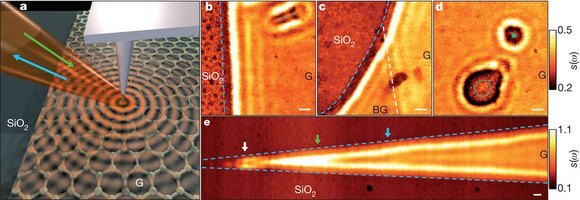
Gate-tuning of graphene plasmons, concept and experimental images (via University of California & Nature)


Graphene is back on the scene once again. Researchers from the University of California have found that they could use the super-material to turn electron waves both on and off by using a simple circuit. The team, led by Professor Dimitri Basov, made the discovery by stripping a 1-atom thick single layer of graphene from graphite. They then rubbed the material onto silicon-oxide chips where they then fired an infra-red laser onto the surface of the chips which created waves of electrons. They then measured the length and height of the oscillations (plasmons) produced using an atomic-force microscope. The team found that when the electrons reached the edge of the graphene surface they reflected back to the point of origin where they then would either add to, or cancel out, the subsequent waves.


The oscillation of plasmons resulted in a pattern which resulted in determining their wavelength and amplitude frequencies. The researchers found that when the connected a pair of electrodes to both the graphene and silicon layers they could alter these patterns which then formed an electrical circuit (or tunable plasmonic device). Theoretically, this method could be used to transmit data through extremely tight spaces where light wave-lengths (hundreds of nano-meters long) can’t squeeze through such as fiber-optics. That would mean that we could have super-efficient and ultrafast processors that would make today’s generation of CPU’s look archaic in comparison.


Another team from Spain, led by Frank Koppens, was successful in creating the same circuit; however they used a gas process to create their graphene sheet instead of shaving it off of graphite. As scientists continue to develop and create new technologies using the super-material, it makes me wonder what else might graphene be used to accomplish.


Cabe

http://twitter.com/Cabe_e14

  • Sign in to reply
  • Catwell
    Catwell over 13 years ago in reply to DAB

    Graphene is easily adaptable of analog filter processes. This definitely fits the bill.


    Cabe

    • Cancel
    • Vote Up 0 Vote Down
    • Sign in to reply
    • More
    • Cancel
  • DAB
    DAB over 13 years ago

    It looks like they can create a tunable waveguide structure.

    If they can maintain the precision, they can probably set these up to amplify signals to very tight quality wavelengths.  Just creating a filter at the nanometer  level would allow bandwidth improvement of current fiber by many factors.


    Lots of potential from this experiment.


    Just my opinion,

    DAB

    • Cancel
    • Vote Up 0 Vote Down
    • Sign in to reply
    • More
    • Cancel
element14 Community

element14 is the first online community specifically for engineers. Connect with your peers and get expert answers to your questions.

  • Members
  • Learn
  • Technologies
  • Challenges & Projects
  • Products
  • Store
  • About Us
  • Feedback & Support
  • FAQs
  • Terms of Use
  • Privacy Policy
  • Legal and Copyright Notices
  • Sitemap
  • Cookies

An Avnet Company © 2025 Premier Farnell Limited. All Rights Reserved.

Premier Farnell Ltd, registered in England and Wales (no 00876412), registered office: Farnell House, Forge Lane, Leeds LS12 2NE.

ICP 备案号 10220084.

Follow element14

  • X
  • Facebook
  • linkedin
  • YouTube