


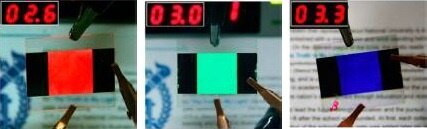
QLEDs producing 168,000 candelas/square meter. (via Jeonghun Kwak & American Chemical Society)
Within time every product meets its predecessor. While quantum dot LEDs (QLEDs) are nothing new, they have taken the back burner to their organic counter parts (OLEDs) for quite some time. Quantum dots are small crystal shaped particles only a few nanometers wide, that behave similarly to semiconductors. They are readily excited by light and their small size and composition give them extraordinary fluorescent optical properties, which are easily adjusted by changing the size or physical composition. Recently, research teams at Seoul University, South Korea, have found a way to improve the color, efficiency, and costs to produce QLEDs.
Seoul National University's Changhee Lee stated that QLEDs suffer from problems due to a large energy barrier between the injected holes from the anode and the transport layer holes. The result is low quantum efficiency, and in turn, low maximum brightness, leakage current, and device degradation. His goal was to correct these issues.
The researchers compensated for this setback by using the usual anode, indium tin oxide, as the electron transport layer, to create a more reliable conductive, efficient product. The new composition of the QLEDs give a greater performance that can be competitive towards the OLEDs.
However, the QLEDs at this time have a much shorter lifespan than OLEDs. They do possess some qualities that make them worth researching further into though. They have a shorter bandwidth which can produce deeper colors and higher contrast ratios. In addition, the ease of adjusting fluorescent properties of quantum dots also make them an appealing product along with their low cost to manufacture, they can be printed easily on a large-area substrate. A breakthrough in QLEDs may soon pave the way for next generation electronic displays and solid-state lighting applications.
Cabe