


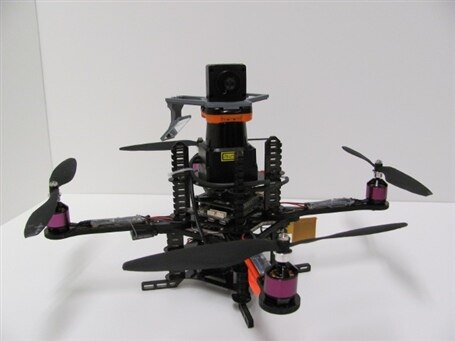
AscTec Pelican quadrotor (via NASA)
While being fixated on the aspect of full-sized drones being the dominating force in the world of UAVs, we tend to over-look the fact that micro autonomous vehicles have their place and are currently undergoing a micro-revolution in their own right. While the larger drones, such as the Predator and the MQ-8 Fire Scout (US Navy VTOL-UAV), are able to be outfitted with devastating fire-power, they are also capable of autonomous flight, which makes them superior over their micro counterparts as they have not been able to achieve this feat. While that certainly may be the case, the larger drones are inferior when it comes to flying in small or enclosed places such as warehouses, nuclear facilities and chemical plants.
The main problem micro-drones have is that they are inferior when it comes to autonomous control; meaning that they can’t take-off, avoid obstacles and land with no human assistance what-so-ever. To handle this issue, researchers from the NASA Jet Propulsion Center (in Pasadena, CA) have designed a MAV (Micro Autonomous Vehicle) that is able to navigate, land and has the ability to identify people and objects. The researchers designed the 19.7in X 19.7in MAV centered on an AscTec Pelican quadrotor platform through which they’ve outfitted it with a down-facing camera that it uses to navigate. The MAV only needs two set of instructions in order for it to navigate; where its current position is and where its destination will be. It uses the camera and the SLAM (Simultaneous Localization and Mapping) software to figure the rest out for itself.
The software uses the camera to build a 3D map on-the-fly which provides the drone an efficient route to the destination and provides the drone with its current location. Using the software suite enables the drone to judge surface heights for possible landing sites and will map-out the area before proceeding to land. The researchers tested the MAV inside of cluttered room where it was successful in taking off, navigating through obstacles and landing onto a stable platform. Further testing will be done on a much larger scale through more complex environments that simulate man-made disasters and urban warfare scenarios. Don't expect to see this MAV hovering outside cocaine-packed warehouses anytime soon, but it is sure to be adopted by the military and search and rescue teams in the very near future.
Cabe

