


Clip from the documentary film "The Camel Race" from 2011
Camel racing is as popular in the UAE (United Arab Emirates) as horse racing is in the west. However, there is a vast difference between the two when it comes to the riders (Jockey’s). Traditionally, until 2005, children were used in ‘The Sport of Sheiks’ as riders until international human rights agencies learned that children, as young as 4, were suffering abuses that ranged from broken bones to starvation. (Starved so they would be as light as possible.)
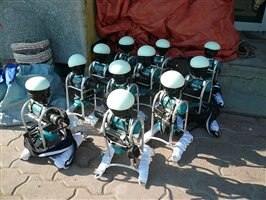
Gen-1 robot-jockeys (via Wiki)
As a replacement, the UAE has adopted robots which were first designed by Rashid Ali Ibrahim from the Qatar Scientific Club in conjunction with an obscure (robotics?) company called ‘Stanley’ back in 2003. These robots were not the performance kings they hoped for so the design was given over to K-Team (a Swiss robotic company) for a revision. After being used to human presence, the camels were naturally afraid of the original robot-jockey design. To overcome that problem, K-Team outfitted the little mechanical jockeys with sunglasses, hats, silk racing-scarves along with a human-like face. If you think that is strange, they also used traditional perfumes once used by human jockeys!
These robots were eventually revised again as the K-team models were heavy and cost about $5,500 US. The latest versions now includes mechanical legs for balance along with robotic arms that pull on the camel’s reins. Also, included is miniature pneumatic actuator that controls a riding-crop which is all controlled remotely by the camel’s owner who rides in a vehicle along-side the track. Recent reports coming out of the UAE say that some robots have were outfitted with shock devices, which are illegal now due to animal-rights activists concerned for the camels well-being.
It is a whole new robotics market for those interested.
See more robots in the element14 Robotics Group.
Cabe
