


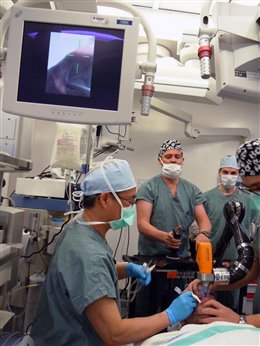
At the McGill University, the world's first intubation robot is being used on real patients. This robot inserts a tube into a patient's trachea (windpipe), the act is called intubation. The robotic system is called the Kepler Intubation System, or KIS, and was developed by Dr. Thomas M. Hemmerling, processor of anesthesia at McGill.
Dr. Hemmerling says that the process of inserting a tube into a patients' airways is a difficult and complex maneuver that requires much experience and mastery. Dr. Hemmerling goes on, "Difficulties arise because of patient characteristics but there is no doubt that there are also differences in individual airway management skills that can influence the performance of safe airway management. These influences may be greatly reduced when the KIS is used."
The KIS allows the operator to operate a mounted video-laryngoscope with a joystick from a remote console. Anesthesiologists can easily see what exactly is happening in the throat of the individual patient, and easily make adjustments to the intubation. Dr. Hemmerling's last statement, "We think that The Kepler Intubation System can assist the anesthesiologist’s arms and hands to perform manual tasks with less force, higher precision and safety. One day, it might actually be the standard practice of airway management."
Eavesdropper