


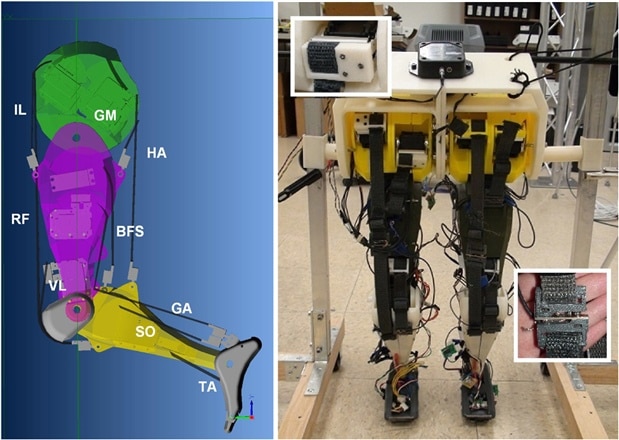
Concept & prototype (via University of Arizona)
Engineers have been trying to design robotic legs that can mimic the way humans walk, but no creation has been truly successful until now. (Ealiest simulating of the human gait was from Georges Moore designed his bi-pedal ‘Steam Man’ back in 1893) A team of researchers from the University of Arizona have designed a pair of robotic legs that, as of this point in time, are the closet to match human locomotion and stride. Designed by M. Anthony Lewis (Robotics and Nueral Systems Laboratory director) and Ph.D student Theresa Klein, the robot is based off of a simplified form of human CPG (Central Pattern Generator), which is a neural network that produces rhythmic patterns without sensory feedback. Simply put; CPG is what enables us to walk without thinking about it.
The teams design features the simplest form of this process known as a ‘half-center’ which fires off just to neurons (alternately) which produces a rhythm. Each leg has a total of 9 actuators for the hip, knee and ankle respectively and is composed of Kevlar straps that act as muscles. The team used Robotis XR-28 motors for each legs GA, SO and VA muscle connections (due to its size and force generation) along with a Futaba S3150 for the TA connection and a Robotis XR-64 for each legs HS, RF and IL connections (see pic above). Each motor ‘pulls’ their corresponding Kevlar straps to simulate the muscle movement in humans while the TA and SO straps provide stability by applying force to both sides of the leg as the foot touches down (front and back). They then used a series of modified Futek FSH01463 Force gage load sensors (located at each strap attachment point) that provide force feedback (like a tendon) when the leg is pushing against a solid surface. While the team designed the legs as a way to give robots the ability to walk more ‘fluidic’ like humans, they also hope doctors may be able to use them as a study guide in an effort to help people with spinal-cord injuries to walk again.
Cabe

