



ViaSat promotional image of the SurfBeam 2 Pro Portable Terminal for newcasting (via ViaSat)
I could have used this at CES. ViaSat is to bring mobile satellite broadband at 12 Mbps in the near future with their SurfBeam 2 Pro Portable system. The system can be setup anywhere within minutes. The whole dish fits inside a carrying case about the size of a suitcase and can be fastened together using only your hands to tighten the connections.
Once assembled, you will be assisted by a GPS system to help locate your position and align the dish correctly. It is as easy as setting the correct elevation, given by GPS, and then panning left or right to find the area with the strongest signal. Once set you are equipped with four port Ethernet router bringing internet at broadband speeds wherever you would like in North America. Additionally, an optional battery pack is available providing up to 4 hours of use to keep from draining your laptop battery.

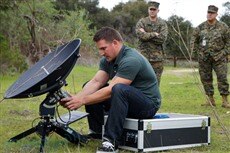
SurfBeam 2 Pro Portable system (via video demo)
Earlier versions of this technology provided up to 350-500kbps of data transfer, where as the SurfBeam provides up to 12Mbps(Megabits per second) download and 3Mbps of upload. It works by transferring data to the ViaSat1, a satellite designed for higher data transfer speeds in geostationary orbit around the Earth.
The technology does not fail to impress with its handling of HD video and a Skype conversation. How the system overcomes the physical distance between the transceiver and the satellite to provide a lag free experience, was not covered. It will be selling for around $20,000 which is above the price range for everyday people. Their focus is towards newscasters, the military, and other emergency organizations who may need to transmit data, news, and videos in remote locations. At first look, the price may seem rather high. Compared to the cost of a satellite truck, which are between $400,000 to millions, it looks like a sure fire win.
A similar, stationary, Sunbeam 2 for residential customers is already available. However, the system is tied down with tiered data plans and a monthly data cap.
The following is a video demonstration:
Cabe
