element14 Community
element14 Community
    Register Log In
  • Site
  • Search
  • Log In Register
  • Community Hub
    Community Hub
    • What's New on element14
    • Feedback and Support
    • Benefits of Membership
    • Personal Blogs
    • Members Area
    • Achievement Levels
  • Learn
    Learn
    • Ask an Expert
    • eBooks
    • element14 presents
    • Learning Center
    • Tech Spotlight
    • STEM Academy
    • Webinars, Training and Events
    • Learning Groups
  • Technologies
    Technologies
    • 3D Printing
    • FPGA
    • Industrial Automation
    • Internet of Things
    • Power & Energy
    • Sensors
    • Technology Groups
  • Challenges & Projects
    Challenges & Projects
    • Design Challenges
    • element14 presents Projects
    • Project14
    • Arduino Projects
    • Raspberry Pi Projects
    • Project Groups
  • Products
    Products
    • Arduino
    • Avnet & Tria Boards Community
    • Dev Tools
    • Manufacturers
    • Multicomp Pro
    • Product Groups
    • Raspberry Pi
    • RoadTests & Reviews
  • About Us
  • Store
    Store
    • Visit Your Store
    • Choose another store...
      • Europe
      •  Austria (German)
      •  Belgium (Dutch, French)
      •  Bulgaria (Bulgarian)
      •  Czech Republic (Czech)
      •  Denmark (Danish)
      •  Estonia (Estonian)
      •  Finland (Finnish)
      •  France (French)
      •  Germany (German)
      •  Hungary (Hungarian)
      •  Ireland
      •  Israel
      •  Italy (Italian)
      •  Latvia (Latvian)
      •  
      •  Lithuania (Lithuanian)
      •  Netherlands (Dutch)
      •  Norway (Norwegian)
      •  Poland (Polish)
      •  Portugal (Portuguese)
      •  Romania (Romanian)
      •  Russia (Russian)
      •  Slovakia (Slovak)
      •  Slovenia (Slovenian)
      •  Spain (Spanish)
      •  Sweden (Swedish)
      •  Switzerland(German, French)
      •  Turkey (Turkish)
      •  United Kingdom
      • Asia Pacific
      •  Australia
      •  China
      •  Hong Kong
      •  India
      • Japan
      •  Korea (Korean)
      •  Malaysia
      •  New Zealand
      •  Philippines
      •  Singapore
      •  Taiwan
      •  Thailand (Thai)
      • Vietnam
      • Americas
      •  Brazil (Portuguese)
      •  Canada
      •  Mexico (Spanish)
      •  United States
      Can't find the country/region you're looking for? Visit our export site or find a local distributor.
  • Translate
  • Profile
  • Settings
Publications
  • Learn
  • More
Publications
Blog Scientists create polymer circuits printed with the help of laser ablation
  • Blog
  • Documents
  • Events
  • Files
  • Members
  • Mentions
  • Sub-Groups
  • Tags
  • More
  • Cancel
  • New
Join Publications to participate - click to join for free!
  • Share
  • More
  • Cancel
Group Actions
  • Group RSS
  • More
  • Cancel
Engagement
  • Author Author: Catwell
  • Date Created: 26 Nov 2012 7:53 PM Date Created
  • Views 430 views
  • Likes 0 likes
  • Comments 0 comments
  • research
  • industry
  • hmi
  • manufacturing
  • circuit
  • on_campus
  • circuit_printing
  • embedded
  • cabeatwell
  • prototyping
  • measurement
  • printing
  • university
  • innovation
  • communication
Related
Recommended

Scientists create polymer circuits printed with the help of laser ablation

Catwell
Catwell
26 Nov 2012

image

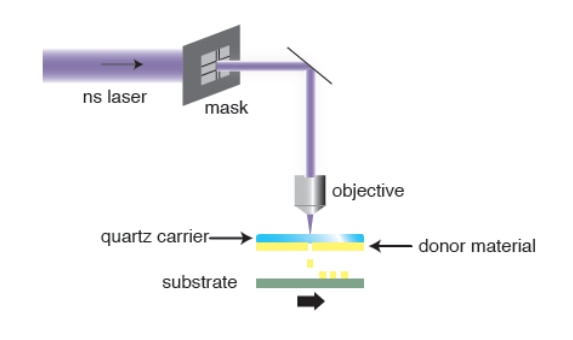
Printing concept (via Laser Induced Forward Transfer of conducting polymers)


Printed polymer circuits have been adapted for use in a wide range of electronics, including smartphones, keyboards and thin solar films. While they are incredibly robust and provide many advantages (cheap to produce, flexibility and lightweight), the conductive polymer (plastic) has its drawbacks, most notably in the manufacturing techniques used to create them. Leading research may have a solution.


Typically, most conductive polymers are created using ‘oxidative coupling of monocyclic precursors’ (or a compound creating another compound through a chemical reaction comprised of some pretty nasty hydrocarbons such as benzene). This process entails using a liquid polymer with a solvent that’s then can either be sprayed or inkjet coated (a form of printing) onto a substrate. However, this process has the tendency to dissolve the layer below (if that layer is also a polymer) or has the capacity of coalescing into a ring (known as the ‘coffee ring affect’) with the polymer concentrating at the outer edge of a droplet. Scientists from the National Technical University of Athens (Greece) have found a novel way around these problems by incorporating laser printing in their manufacturing process.


Led by Maria Kandyla, the team used laser ablation (or vaporization of material) to deposit a conductive polymer onto the substrate rather than using the solvent method to make a circuit. To make the circuit, the team first deposited a layer of conducting polymer on a substrate of glass (called the ‘donor substrate’), which is done by the more traditional method of spin-coating - allowed to cure (just like it sounds; a dab of liquid polymer material is placed in the center of the substrate and then rotated at high speed). The team then placed the ‘receiving’ substrate next to the face of the donor, separated by a few micrometers, and then a laser is fired through the glass substrate which dissolves or detaches a small amount of the conductive polymer onto the receiving substrate. The circuit is created by moving the two substrates during the laser-firing process to deposit 2D patterns (in any shape), which makes the circuit. Since the transfer process is done with solid polymers, the problems associated by using solvents is avoided. So far the team has tested their method successfully using P3HT:PCBM, which is commonly found in thin-film photovoltaic cells, as well as using polyaniline to print up biological sensor circuits. Perhaps more than organic LEDs will be made with the process in the near future.


Cabe

http://twitter.com/Cabe_e14

  • Sign in to reply
element14 Community

element14 is the first online community specifically for engineers. Connect with your peers and get expert answers to your questions.

  • Members
  • Learn
  • Technologies
  • Challenges & Projects
  • Products
  • Store
  • About Us
  • Feedback & Support
  • FAQs
  • Terms of Use
  • Privacy Policy
  • Legal and Copyright Notices
  • Sitemap
  • Cookies

An Avnet Company © 2025 Premier Farnell Limited. All Rights Reserved.

Premier Farnell Ltd, registered in England and Wales (no 00876412), registered office: Farnell House, Forge Lane, Leeds LS12 2NE.

ICP 备案号 10220084.

Follow element14

  • X
  • Facebook
  • linkedin
  • YouTube