


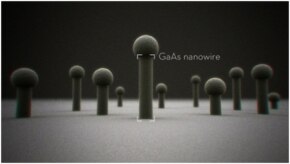
Graphene Nano-wire on graphene concept (via Crayonano)
With all of the latest developments regarding graphene production and applications, could we finally be on the verge of running 3000GHz CPU’s on our systems and mobile devices? According to a team of scientists from the Norwegian University of Science and Technology, that day might be closer than you think. Their development is a semiconductor nano-wire that has been grown on the metamaterial, which could be described as tiny, yet powerful, electronic mushrooms. This is the first commercialized semiconductor grown on graphene.
To create their GaAs nanowires the team used a process known as molecular beam epitaxy (MBE) which is used to deposit crystals in a high-vacuum chamber to create semiconductor films. However in this case the scientists substituted gallium atoms and arsenic molecules rather than silicon. These gallium atoms were bombarded against an atom-thick graphene surface where they then bonded to the substrate. Over time, the gallium atoms combine together to form tiny droplets, which arrange themselves with the graphene’s hexagonal lattice structure. The group then introduced the arsenic molecules to the mix which would sink to the bottom of the gallium droplets which then combined with each-other to form a crystalline structure on the point of contact with the graphene. As more arsenic molecules and gallium atoms combine the resulting crystalline structure continues to grow into a nano-wire with the initial gallium droplet perched at the top. After a few minutes the semiconductor nano-wire fabrication process is finished with an end-result of a pliable transparent base that could be adapted to new, and relatively cheap, solar cells and LED’s. The scientists state that their findings aren’t meant as a new product but rather a new method for fabrication of graphene-based semiconductor devices. This production method could introduce flexible touch screens for mobile devices, such as a smartphone screen that wraps around your wrist or implemented into solar-cells that could be fabricated into the windows of your home.
Cabe
