element14 Community
element14 Community
    Register Log In
  • Site
  • Search
  • Log In Register
  • Community Hub
    Community Hub
    • What's New on element14
    • Feedback and Support
    • Benefits of Membership
    • Personal Blogs
    • Members Area
    • Achievement Levels
  • Learn
    Learn
    • Ask an Expert
    • eBooks
    • element14 presents
    • Learning Center
    • Tech Spotlight
    • STEM Academy
    • Webinars, Training and Events
    • Learning Groups
  • Technologies
    Technologies
    • 3D Printing
    • FPGA
    • Industrial Automation
    • Internet of Things
    • Power & Energy
    • Sensors
    • Technology Groups
  • Challenges & Projects
    Challenges & Projects
    • Design Challenges
    • element14 presents Projects
    • Project14
    • Arduino Projects
    • Raspberry Pi Projects
    • Project Groups
  • Products
    Products
    • Arduino
    • Avnet & Tria Boards Community
    • Dev Tools
    • Manufacturers
    • Multicomp Pro
    • Product Groups
    • Raspberry Pi
    • RoadTests & Reviews
  • About Us
  • Store
    Store
    • Visit Your Store
    • Choose another store...
      • Europe
      •  Austria (German)
      •  Belgium (Dutch, French)
      •  Bulgaria (Bulgarian)
      •  Czech Republic (Czech)
      •  Denmark (Danish)
      •  Estonia (Estonian)
      •  Finland (Finnish)
      •  France (French)
      •  Germany (German)
      •  Hungary (Hungarian)
      •  Ireland
      •  Israel
      •  Italy (Italian)
      •  Latvia (Latvian)
      •  
      •  Lithuania (Lithuanian)
      •  Netherlands (Dutch)
      •  Norway (Norwegian)
      •  Poland (Polish)
      •  Portugal (Portuguese)
      •  Romania (Romanian)
      •  Russia (Russian)
      •  Slovakia (Slovak)
      •  Slovenia (Slovenian)
      •  Spain (Spanish)
      •  Sweden (Swedish)
      •  Switzerland(German, French)
      •  Turkey (Turkish)
      •  United Kingdom
      • Asia Pacific
      •  Australia
      •  China
      •  Hong Kong
      •  India
      • Japan
      •  Korea (Korean)
      •  Malaysia
      •  New Zealand
      •  Philippines
      •  Singapore
      •  Taiwan
      •  Thailand (Thai)
      • Vietnam
      • Americas
      •  Brazil (Portuguese)
      •  Canada
      •  Mexico (Spanish)
      •  United States
      Can't find the country/region you're looking for? Visit our export site or find a local distributor.
  • Translate
  • Profile
  • Settings
Publications
  • Learn
  • More
Publications
Blog Sensor tracks chewing, talking and other mouth-related activities
  • Blog
  • Documents
  • Events
  • Files
  • Members
  • Mentions
  • Sub-Groups
  • Tags
  • More
  • Cancel
  • New
Join Publications to participate - click to join for free!
  • Share
  • More
  • Cancel
Group Actions
  • Group RSS
  • More
  • Cancel
Engagement
  • Author Author: Catwell
  • Date Created: 29 Aug 2013 7:22 PM Date Created
  • Views 751 views
  • Likes 1 like
  • Comments 1 comment
  • research
  • test
  • industry
  • hmi
  • cabeatwell
  • prototyping
  • measurement
  • medical
  • technology_for_the_disabled
  • sensor
  • innovation
  • communication
Related
Recommended

Sensor tracks chewing, talking and other mouth-related activities

Catwell
Catwell
29 Aug 2013

image

Spy level secret sensors everywhere... can we trust anyone? (via National Taiwan University)


Remember when the dentist told you to lay off the crunchy sweets? Have you ever wondered just how much you talk, eat or drink? Soon a little implanted sensor that fits aside your molar could tell you and your physician a lot about your oral activity. Researcher Hao-Hua Chu and his team from the National Taiwan University at Taipei have begun to develop such a device and have made great progress in teaching it to recognize oral activities like coughing and eating. It could one day tell you if you grind your teeth in your sleep via your smartphone.


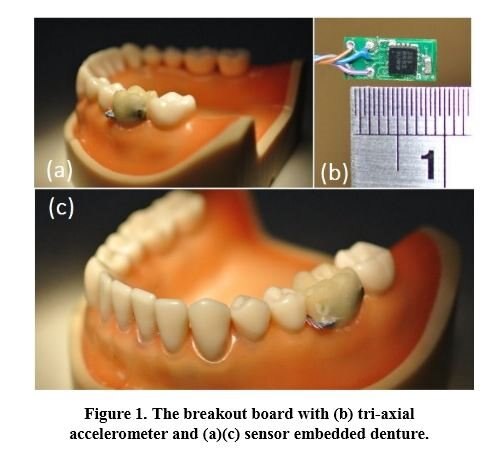
The device consists of a tiny 4.5mm x 10mm circuit containing a tri-axial accelerometer, coated in dental resin, and currently fits inside dentures or a dental brace; in time it is expected to also fit in a tiny tooth cavity or a crown. This prototype is powered using an external battery but the team is searching for rechargeable micro-batteries that will get rid of the necessary wires. As mentioned above, the Teeth Probe will one day communicate with your smartphone, using Bluetooth. The effects of propagating microwaves on oral tissue has not been extensively studied so integrating this tech into the probe will have to wait till favorable research is obtained.


The team is experimenting with different software algorithms that will teach the probe to recognize actions. The team experimented using C4.5 Decision Tree (C4.5 DT), Multivariate Logistic Regression (MVR), and Support Vector Machine (SVM) to help the device turn accelerometer readings into actions. They also applied these three methods to two models: one person-dependent model which learned personal movements and a more general person-independent model which tried to gather info from 7 participants in order to detect the oral activity of the 8th participant.


The results showed that the most effective algorithm to use was the SVM to detect talking, eating, drinking and coughing. The performance of the SVM algorithm was much better in the personal-dependent model, scoring over 90% correct recognition or more for all activities.


The SVM, person-independent approach was far less effective at recognizing activity, resulting in about 60% accuracy. The team says this is due to a couple different reasons. First, every person has a different oral structure, which means that the device will always be implanted in a different location and thus changes how the dental probe detects motion. Another reason is that every person performs these activities at different rates and different levels of force. Taking these factors into account, the team will be able to improve the general person-independent model.


The team wants to use the device to study people who clench or grind their teeth. For others, it could monitor the frequency of different oral activities, “mouth motion” data that can be sent, stored and shared through a patient’s smartphone. This could help patients and doctors assess the effectiveness or need for different dental interventions.


The team’s results will be made available at this year’s International Symposium on Wearable Computers in Zurich.


C

See more news at:

http://twitter.com/Cabe_Atwell

  • Sign in to reply
  • DAB
    DAB over 12 years ago

    I agree that this application would be very useful in dental analysis.


    Some people do some really wierd things while they dream. (like the dog wagging its tail and moving its paws while asleep)


    Having had TMJ, I could see using the sensors to measure bite changes due to muscle/bone damage in instances where extreme trauma has occured.


    As for anyone wanting to know how much I use my mouth each day, I do not really see where that data would be of use, but then I do not spend much time talking.  I am too busy doing things.


    Just a thought,

    DAB

    • Cancel
    • Vote Up 0 Vote Down
    • Sign in to reply
    • More
    • Cancel
element14 Community

element14 is the first online community specifically for engineers. Connect with your peers and get expert answers to your questions.

  • Members
  • Learn
  • Technologies
  • Challenges & Projects
  • Products
  • Store
  • About Us
  • Feedback & Support
  • FAQs
  • Terms of Use
  • Privacy Policy
  • Legal and Copyright Notices
  • Sitemap
  • Cookies

An Avnet Company © 2026 Premier Farnell Limited. All Rights Reserved.

Premier Farnell Ltd, registered in England and Wales (no 00876412), registered office: Farnell House, Forge Lane, Leeds LS12 2NE.

ICP 备案号 10220084.

Follow element14

  • X
  • Facebook
  • linkedin
  • YouTube